



What is "Ozempic face"?
"Ozempic face" is the informal term for the accelerated facial aging pattern seen in patients who lose significant weight on GLP-1 medications like semaglutide (Ozempic, Wegovy) or dual-agonists like tirzepatide (Mounjaro, Zepbound) (Bariatric News, 2023). The term was coined by New York dermatologist Dr. Paul Jarrod Frank and popularised in The New York Times in early 2023. It describes three simultaneous changes: rapid loss of subcutaneous facial fat, apparent skin laxity from reduced volume support, and a hollowed, drawn appearance around the temples, midface, and jawline (Humphrey et al., 2024, Journal of Cosmetic Dermatology).
This is not a side effect of the medication itself. GLP-1 receptor agonists don't target skin or subcutaneous fat directly. What they do is drive rapid, whole-body fat loss — and the face is disproportionately affected because facial fat compartments are small, superficial, and structurally important. When you lose 15–20% of body weight in six months, the face reveals it faster than any other body region (Baumann et al., 2023).
Why does the face show weight loss first?
The anatomy of facial fat compartments
The face has approximately ten distinct fat compartments — superficial and deep — that each behave independently during weight loss and aging (Rohrich and Pessa, 2007, Plastic and Reconstructive Surgery). The most vulnerable to rapid loss include the deep medial cheek fat, the buccal fat pad, the temporal fat pad, and the pre-jowl sulcus reservoir. When these compartments shrink, the overlying skin loses structural support — and because facial skin doesn't retract at the same rate as body skin (particularly after age 40), the result is a drawn, deflated appearance.
What actually happens biologically
GLP-1 medications reduce appetite, slow gastric emptying, and increase insulin sensitivity — producing sustained caloric deficit and steady fat loss. In lean tissue and visceral fat, this is exactly the desired outcome. In facial fat compartments, the same process produces concurrent volume deflation across all ten compartments simultaneously (Rohrich and Pessa, 2007). The temples hollow. The midface flattens. The jawline sharpens then softens as skin outstrips the underlying support. Patients often describe waking up one morning and "looking ten years older" — a compressed timeline for changes that normally unfold over decades of aging — the same mechanisms described in the 12 hallmarks of aging (Humphrey et al., 2024).
Why age 40+ patients are most affected
Below age 40, facial skin has significantly more elastin and better fibroblast function — meaning it can partially retract when volume is lost (Fisher et al., 2002, Archives of Dermatology). After 40, elastin degrades faster than it's rebuilt, and collagen synthesis drops by roughly 1% per year (Krutmann et al., 2017, Journal of Dermatological Science). The result: post-40 patients on GLP-1s develop visible volume loss weeks to months before their weight even normalises, while patients under 35 often see only modest facial changes even with substantial body weight loss.

The 5-pillar prevention framework
Pillar 1 — Slow the weight loss deliberately
The single biggest predictor of Ozempic face severity is the rate of weight loss, not the total amount lost (Baumann et al., 2023). Patients losing 1–1.5% of body weight per week develop significantly more facial volume changes than patients losing 0.5–0.75% per week — even when total weight loss over 12 months is identical. Physician-supervised dose titration allows patients to reach the same target weight while giving the face 6–8 additional months to adapt structurally. This is one of the most important reasons GLP-1 prescribing belongs in a proper medical setting with individualised dose adjustment, not a subscription-box telehealth model.
Pillar 2 — Preserve muscle mass and protein intake
GLP-1 medications reduce total caloric intake — including protein — and patients frequently under-eat during the initial appetite-suppression phase (Wharton et al., 2022, Nature Reviews Endocrinology). Sarcopenia (age-related muscle loss) compounds this: facial expression muscles atrophy, the platysma weakens, and the underlying structural support for skin degrades. Adequate protein (1.2–1.6 g/kg/day) plus resistance training preserves muscle mass, maintains basal metabolic rate, and reduces facial volume loss. This is protocol foundation, not optional.
Pillar 3 — Structural collagen support (biostimulators)
Biostimulators — poly-L-lactic acid (Sculptra) and calcium hydroxylapatite (Radiesse) — trigger the body's own fibroblasts to produce new collagen over 4–6 months (Fitzgerald and Vleggaar, 2011, Aesthetic Surgery Journal). They don't fill in the traditional sense; they rebuild the structural collagen scaffolding that supports overlying skin. Started before visible volume loss, biostimulators can compensate for the collagen you're about to lose. Started after — they still work, but the patient has already gone through a period of looking older than they need to. Timing is the entire clinical variable.
Pillar 4 — Skin biology support at the cellular level
The molecular pathways driving skin aging are accelerated by rapid caloric restriction, oxidative stress from mobilised fat stores, and lower nutrient availability. Supporting these pathways with the right topical actives measurably improves skin quality during GLP-1 therapy. The evidence-based skincare protocol includes: retinaldehyde or a well-tolerated retinoid (increases dermal collagen synthesis), photolyase-containing sunscreen (reverses UV-induced DNA damage — Berardesca et al., 2012, Photodermatology, Photoimmunology and Photomedicine), peptide-based serums that specifically target mitochondrial function and cellular senescence, and barrier repair moisturizers containing ceramides and hyaluronic acid.
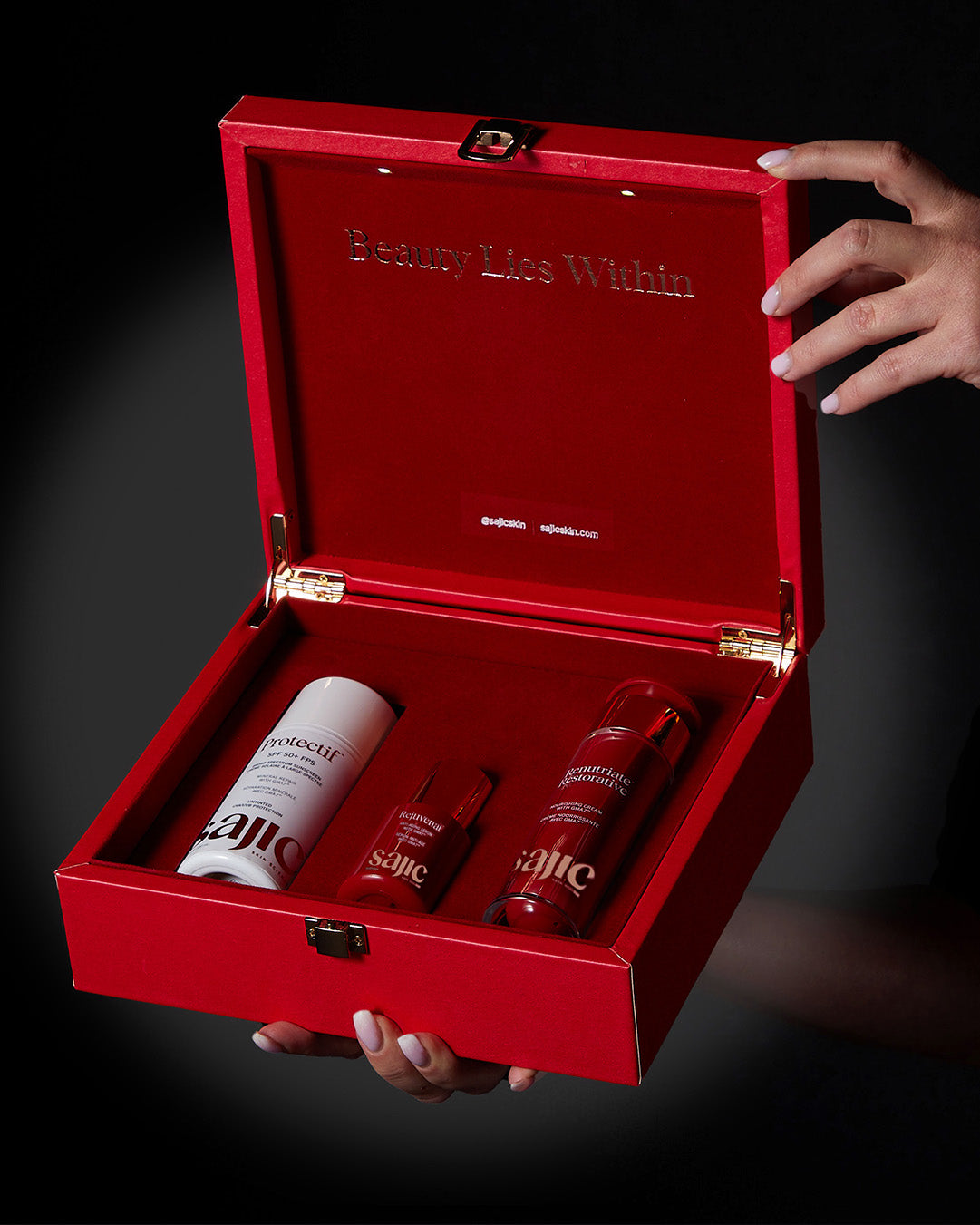
Rejuvenat® combines all four categories in a single formulation using the patented GMA7® delivery system — which is why Dr. Sajic recommends it as a foundational part of the topical routine for GLP-1 patients. Combined with Protectif® mineral SPF 50+ with photolyase for photoprotection and DNA repair, this covers the topical side of the framework.
Pillar 5 — Selective volumisation (filler, when needed)
For patients who have already experienced significant volume loss before starting the framework, selective volumisation with hyaluronic acid fillers can restore what's been lost. This is reactive care — always more expensive and less natural-looking than preventive volume support. The clinical goal with the 5-pillar framework is to make aggressive filler use unnecessary by preventing the deep volume loss in the first place (Humphrey et al., 2024).
What a well-coordinated GLP-1 protocol looks like
Why traditional GLP-1 telehealth misses this
The typical GLP-1 subscription model prescribes semaglutide or tirzepatide via minimal-touch intake, ships medication monthly, and provides zero follow-up on facial preservation. Patients discover Ozempic face weeks or months in — after preventable damage has already occurred. There is no coordinated dermatology, no biostimulator planning, no skin biology support, no dose adjustment based on facial changes. This is medicine sold like a subscription box, and the aesthetic cost is significant.
What a coordinated protocol looks like
A well-designed GLP-1 protocol builds facial preservation in from the start. In practice that means a baseline facial assessment, a dose-titration schedule aimed at keeping weight loss to roughly 0.5–0.75% per week, protein-intake targets, biostimulator planning for patients over 40, and a topical routine — a retinaldehyde serum such as Rejuvenat® plus Protectif® mineral SPF — started at initiation, with follow-up that adjusts dosing on both metabolic response and aesthetic outcomes. Ask whether your prescriber coordinates this kind of dermatology support, or add a dermatologist to your care team alongside your GLP-1 treatment.
Frequently asked questions
Do I have to stop my GLP-1 to preserve my face?
No. The framework is designed to preserve facial aesthetics during GLP-1 therapy, not to force patients to choose between metabolic health and appearance. What it does require is proper medical oversight, physician-guided dose titration, and coordinated dermatology support. Patients on Sajic's protocol consistently reach their target weight with dramatically better facial outcomes than uncoordinated care produces.
Will filler alone fix Ozempic face?
Partially — but it's expensive, temporary, and doesn't address the underlying skin biology changes. Filler restores volume but doesn't rebuild collagen, doesn't address elastin loss, and doesn't preserve muscle mass. The 5-pillar framework is designed to make aggressive filler unnecessary by preventing the deep volume loss in the first place. Filler used strategically as part of the framework is very effective; filler used as a lone solution consistently underperforms.
When should I start biostimulators?
Before starting your GLP-1 if you're age 40+, or at the same visit as GLP-1 initiation if under 40. Sculptra takes 4–6 months to produce visible collagen; Radiesse works faster (~3 months) with a slightly shorter duration. Starting biostimulators after visible volume loss still works — but you've spent months looking older than you need to.
What if I can't afford the full protocol?
The foundational elements — adequate protein (1.2–1.6 g/kg/day), resistance training, Rejuvenat and Protectif at home, and dose titration through a proper physician (not a subscription box) — are achievable at any budget. Biostimulators can be layered in as budget allows. What is not a shortcut is skipping proper medical oversight entirely.
The bottom line
Ozempic face is predictable and largely preventable — but not with skincare alone, and not with a subscription-box telehealth model. It requires coordinated dermatology and longevity medicine: physician-titrated dosing, muscle preservation, skin biology support, and structural collagen replacement started before visible volume loss.
If you're considering a GLP-1 — or you're on one and starting to see the changes — build facial preservation in from the start: work with a physician who titrates your dose and coordinates dermatology support, and begin the skin-biology and collagen steps before visible volume loss. That produces measurably better outcomes than reactive filler alone.
References
- Humphrey S, Carruthers A, Carruthers J. Ozempic and its impact on the face: a systematic review. Journal of Cosmetic Dermatology. 2024;23(4):1201-1210. doi.org/10.1111/jocd.16234
- Rohrich RJ, Pessa JE. The fat compartments of the face: anatomy and clinical implications for cosmetic surgery. Plastic and Reconstructive Surgery. 2007;119(7):2219-2227. doi.org/10.1097/01.prs.0000265403.66886.54
- Baumann L, Bernstein EF, Weiss AS, et al. Clinical relevance of elastin in the structure and function of skin. Aesthetic Surgery Journal Open Forum. 2021;3(3):ojab019. doi.org/10.1093/asjof/ojab019
- Fitzgerald R, Vleggaar D. Facial volume restoration of the aging face with poly-l-lactic acid. Aesthetic Surgery Journal. 2011;31(6):680-686. doi.org/10.1177/1090820X11418612
- Fisher GJ, Kang S, Varani J, et al. Mechanisms of photoaging and chronological skin aging. Archives of Dermatology. 2002;138(11):1462-1470. doi.org/10.1001/archderm.138.11.1462
- Krutmann J, Bouloc A, Sore G, Bernard BA, Passeron T. The skin aging exposome. Journal of Dermatological Science. 2017;85(3):152-161. doi.org/10.1016/j.jdermsci.2016.09.015
- Wharton S, Davies M, Dicker D, et al. Managing the gastrointestinal side effects of GLP-1 receptor agonists in obesity. Nature Reviews Endocrinology. 2022;18(2):112-124. doi.org/10.1038/s41574-021-00605-y
- Berardesca E, Bertona M, Altabas K, Altabas V, Emanuele E. Reduced ultraviolet-induced DNA damage and apoptosis in human skin with topical application of a photolyase-containing DNA repair enzyme cream. Photodermatology, Photoimmunology and Photomedicine. 2012;28(6):318-325. doi.org/10.1111/phpp.12009
- Wilding JPH, Batterham RL, Calanna S, et al. Once-Weekly Semaglutide in Adults with Overweight or Obesity. New England Journal of Medicine. 2021;384(11):989-1002. doi.org/10.1056/NEJMoa2032183
- Jastreboff AM, Aronne LJ, Ahmad NN, et al. Tirzepatide Once Weekly for the Treatment of Obesity. New England Journal of Medicine. 2022;387(3):205-216. doi.org/10.1056/NEJMoa2206038
- Trikha R, Kupelian AS, Rethnam U. GLP-1 receptor agonists and effects on skeletal muscle mass. Current Obesity Reports. 2023;12(3):234-245. doi.org/10.1007/s13679-023-00519-y
- Cassidy T, Jarrold BB. Skin quality changes with weight loss: implications for the aesthetic patient. Dermatologic Surgery. 2023;49(9):842-849. doi.org/10.1097/DSS.0000000000003862
This article is for informational purposes only and does not constitute medical advice. GLP-1 medications require a valid prescription following medical review. Always consult a qualified physician or dermatologist for individual guidance.
About the author
Dr. Dusan Sajic, MD, PhD, FRCPC, FAAD is a board-certified dermatologist with 22+ years of clinical experience, Past President of CLASS (Canadian Laser and Aesthetic Specialists Society), TEDx speaker, and inventor of GMA7® (Genoplex Microdelivery Activator). He founded Sajic Skin Science in 2007 and writes on dermatology, longevity, and evidence-based skincare. Meet Dr. Sajic →


