



Ozempic face before and after: what's actually happening to your skin?
"Ozempic face before and after" photos show the same pattern again and again: a slimmer jaw and cheeks, but also hollow temples, flatter midface, and skin that suddenly looks looser and older. Here's the key point most before-and-after galleries miss — the medication did not age your skin. Rapid fat loss simply removed the volume that was holding your face up, and the skin, especially after 40, can't retract fast enough to keep pace (Rohrich and Pessa, 2007).
Understanding the "before" and the "after" biologically is what makes the change preventable rather than inevitable. This guide breaks down exactly what shifts between the two photos, why some people show it dramatically and others barely at all, and what actually protects skin quality during GLP-1 weight loss.
What changes between the "before" and the "after"?
Three shifts happening at once
A convincing "Ozempic face" before-and-after is really three simultaneous changes. First, subcutaneous fat loss deflates the cheeks, temples, and under-eye area. Second, apparent laxity appears as skin that used to drape over a fuller structure now has less to cover. Third, shadowing and contour change — hollows catch light differently, which is why the face can read as older even when the number on the scale is a success (Rohrich and Pessa, 2007).
Why the face shows it first
The face carries roughly ten small, superficial fat compartments that sit directly under thin, mobile skin. When you lose 15–20% of body weight, those compartments shrink alongside every other fat store in the body — but because they are small and structurally load-bearing, the visible effect is disproportionate (Rohrich and Pessa, 2007). Body skin over larger fat stores hides gradual loss; facial skin cannot.

Why are some before-and-afters dramatic and others barely noticeable?
Rate of loss is the biggest variable
Two people can lose the same total weight and look completely different afterward. The difference is usually how fast they lost it. Faster loss gives skin and its underlying support less time to adapt, producing a more abrupt "after." This is one of the strongest arguments for physician-guided, gradual dose titration rather than chasing the quickest possible result (Wilding et al., 2021; Jastreboff et al., 2022).
Age and baseline skin quality
Below about 40, skin has more functional elastin and more active fibroblasts, so it can partially retract as volume drops (Fisher et al., 2002). After 40, collagen synthesis declines and elastin degrades faster than it's replaced, so the same volume loss reads as more laxity. Sun damage, smoking history, and genetics all shift where a given person lands on that spectrum. This is why prevention is personal — a 35-year-old and a 55-year-old on identical protocols will not have identical "after" photos.
Can you prevent a dramatic Ozempic-face transformation?
What you can and can't control
You cannot stop the face from losing fat as you lose weight — that's the mechanism of the treatment working. What you can influence is skin quality: how much collagen you preserve and stimulate, how intact your barrier stays, and how much photoaging you prevent along the way. Better skin quality means the "after" face — even with less volume — looks healthier, firmer, and less crepey.
The skin-support routine that helps
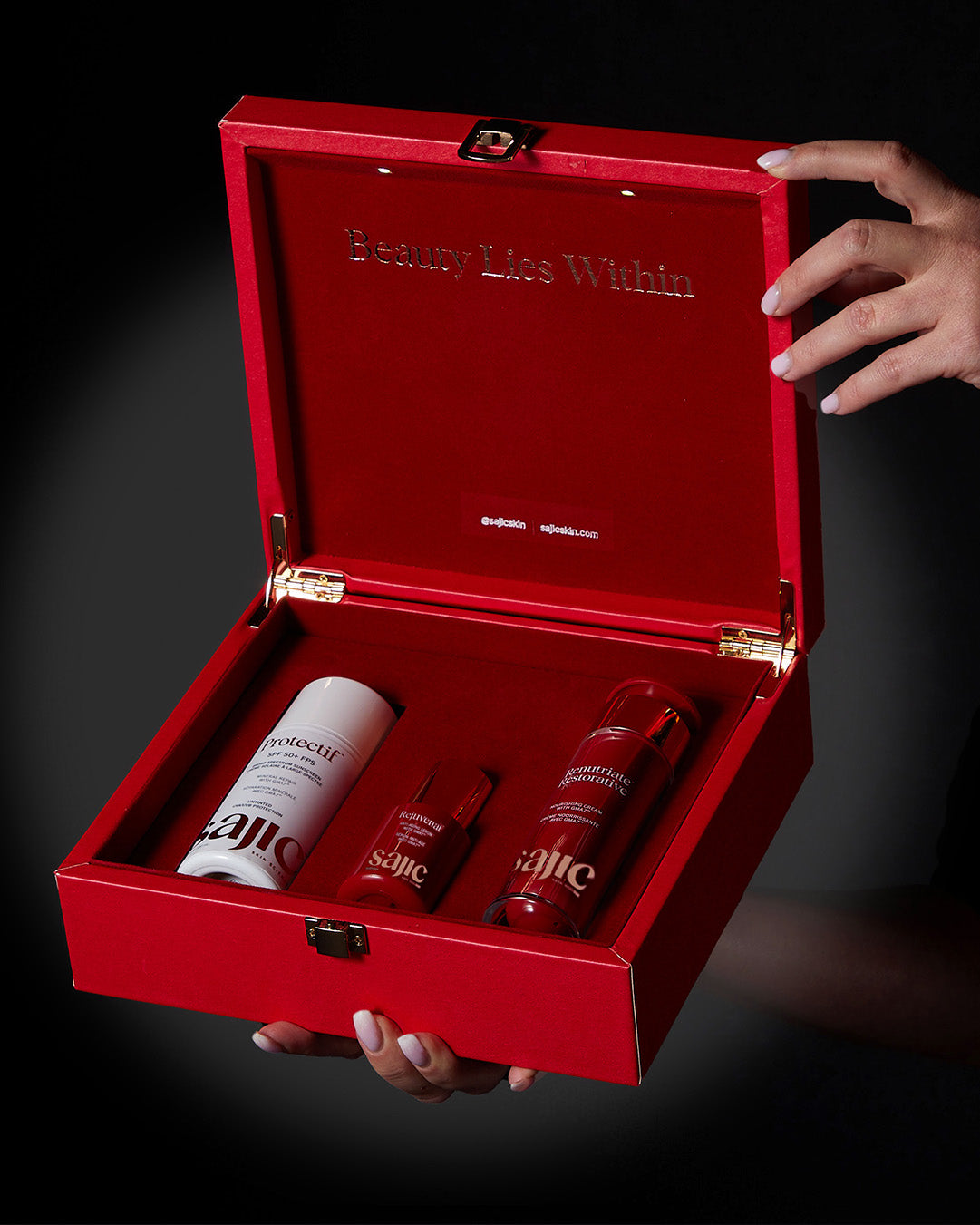
The evidence-based topical routine during GLP-1 therapy has three jobs: stimulate collagen, protect the barrier, and prevent UV damage that accelerates laxity. That means a well-tolerated retinoid (see our guide to retinol vs retinaldehyde vs retinoic acid), a peptide- and barrier-supportive serum, and a mineral sunscreen with DNA-repair support such as photolyase. Rejuvenat® combines retinaldehyde, five peptides, and photolyase in the GMA7® delivery system for exactly this window. None of this replaces volume — but it changes how the skin that remains looks and ages.
The deeper "why" behind accelerated facial aging — the collagen, elastin, and cellular changes rapid weight loss compresses into months — is the same biology covered in the 12 hallmarks of aging and cellular senescence.
How do muscle and protein change the "after"?
Skin needs something to drape over
Facial and body skin sit over muscle as well as fat. When rapid weight loss strips muscle along with fat — common when appetite suppression pushes protein intake too low — the face loses part of its underlying scaffold, and the "after" reads slacker than fat loss alone would explain (Wharton et al., 2022). The platysma and the muscles of facial expression are part of what holds the lower face and jawline in place; let them atrophy and the skin above them has less support.
Practical targets you control
Clinicians managing GLP-1 patients typically aim for roughly 1.2–1.6 g of protein per kg of body weight per day, paired with resistance training two to three times a week. This preserves lean mass, supports basal metabolic rate, and keeps the structural base under the skin intact. It is the single cheapest, highest-yield step for a better before-and-after — and it is the one patients most often neglect during the early appetite-suppression phase, precisely when eating enough feels hardest.
What does the change look like month by month?
A rough timeline
Because the facial change tracks fat loss, it follows the weight-loss curve. In the first 4–8 weeks, most people notice little beyond initial slimming. Between months 2 and 4 — when weight loss is often fastest — the temples and midface can flatten noticeably, and this is when patients most often say they "suddenly" look older. From months 4 to 9, as loss continues, laxity and jawline softening become more apparent, especially over 40. Once weight stabilises, the face settles, and skin quality — how firm and smooth it looks at the new volume — becomes the main variable you can still influence.
Why the timeline matters for skincare
The window to act is before and during the fastest loss, not after it. Collagen stimulation from a retinoid takes 12 weeks to 6 months to show, so starting at initiation means the support is building exactly as the volume drops. Beginning only once the hollowing is obvious means months of playing catch-up.
Where do biostimulators and filler fit?
Topicals and muscle preservation protect skin quality, but they don't restore lost volume. That's where in-office options come in — and timing again decides the result. Biostimulators such as poly-L-lactic acid and calcium hydroxylapatite prompt your own fibroblasts to build collagen over 4–6 months, rebuilding structural support rather than simply filling (Fitzgerald and Vleggaar, 2011). Started before or during significant loss, they can offset volume you're about to lose; started after, they still work but you've spent months looking older than necessary. Hyaluronic-acid filler restores volume faster but is reactive and temporary. Any of these should be planned with a qualified physician — ideally alongside, not instead of, the skin-quality steps above.
Frequently asked questions
Does Ozempic face reverse if I stop the medication or regain weight?
Partially. If fat returns, some facial volume returns with it — but skin that has stretched and lost elasticity does not always snap back, particularly after 40. Regaining weight to "fix" your face is not a sound strategy; supporting skin quality and, where appropriate, volume restoration under a physician is the better path.
How long after starting a GLP-1 does the "after" face appear?
It tracks weight loss, so it often becomes visible within the first few months — sometimes before weight even normalises, especially in patients over 40 who lose quickly. This is why starting skin support at initiation, not after the hollowing shows, matters.
Will skincare alone fix Ozempic face?
No — and any product claiming to "reverse" volume loss topically is overpromising. Skincare improves skin quality (firmness, texture, barrier, photoprotection). Volume loss is addressed by a physician through dose pacing and, when needed, biostimulators or filler. The two work together, not interchangeably.
Is Ozempic face different on Wegovy or Mounjaro?
The mechanism is the same — all cause rapid fat loss that the face reveals. The main difference is degree: faster or greater weight loss tends to produce a more pronounced change, regardless of which drug drives it.
The bottom line
The "before" and "after" of Ozempic face is a story about volume, not damage. The medication reveals facial fat loss the small, superficial fat pads can't hide — and skin over 40 can't retract fast enough to keep up. You can't stop your face from participating in whole-body fat loss, but you can protect the quality of the skin that remains.
Pace the weight loss with a physician, protect muscle and protein intake, start collagen-supportive skincare — retinaldehyde, peptides, and mineral photoprotection like Rejuvenat® and Protectif® — before the change shows, and coordinate dermatology support for volume where needed. Read the full framework in the Ozempic face prevention guide, and if laxity is already your main concern, see loose and sagging skin after weight loss.
References
- Rohrich RJ, Pessa JE. The fat compartments of the face: anatomy and clinical implications for cosmetic surgery. Plastic and Reconstructive Surgery. 2007;119(7):2219-2227. doi.org/10.1097/01.prs.0000265403.66886.54
- Fisher GJ, Kang S, Varani J, et al. Mechanisms of photoaging and chronological skin aging. Archives of Dermatology. 2002;138(11):1462-1470. doi.org/10.1001/archderm.138.11.1462
- Wilding JPH, Batterham RL, Calanna S, et al. Once-weekly semaglutide in adults with overweight or obesity. New England Journal of Medicine. 2021;384(11):989-1002. doi.org/10.1056/NEJMoa2032183
- Jastreboff AM, Aronne LJ, Ahmad NN, et al. Tirzepatide once weekly for the treatment of obesity. New England Journal of Medicine. 2022;387(3):205-216. doi.org/10.1056/NEJMoa2206038
- Krutmann J, Bouloc A, Sore G, Bernard BA, Passeron T. The skin aging exposome. Journal of Dermatological Science. 2017;85(3):152-161. doi.org/10.1016/j.jdermsci.2016.09.015
- Wharton S, Davies M, Dicker D, et al. Managing the gastrointestinal side effects of GLP-1 receptor agonists in obesity. Nature Reviews Endocrinology. 2022;18(2):112-124. doi.org/10.1038/s41574-021-00605-y
- Fitzgerald R, Vleggaar D. Facial volume restoration of the aging face with poly-L-lactic acid. Aesthetic Surgery Journal. 2011;31(6):680-686. doi.org/10.1177/1090820X11418612
This article is for informational purposes only and does not constitute medical advice. GLP-1 medications require a valid prescription following medical review. Always consult a qualified physician or dermatologist for individual guidance.
About the author
Dr. Dusan Sajic, MD, PhD, FRCPC, FAAD is a board-certified dermatologist with 22+ years of clinical experience, Past President of CLASS (Canadian Laser and Aesthetic Specialists Society), TEDx speaker, and inventor of GMA7® (Genoplex Microdelivery Activator). He founded Sajic Skin Science in 2007 and writes on dermatology, longevity, and evidence-based skincare. Meet Dr. Sajic →


