



Loose and sagging skin after weight loss: what actually helps?
Loose skin after significant weight loss is common, and the honest answer is that no cream tightens skin the way surgery does — but that's not the whole story. How much loose skin you develop, and how well it firms over time, depends heavily on factors you can influence: the pace of your weight loss, your protein and muscle status, sun protection, and the collagen and barrier support you give your skin (Fisher et al., 2002). This dermatologist's guide covers what's realistic without surgery, what genuinely improves skin firmness and quality, and when to consider in-office or surgical options.
Why does skin get loose after losing weight?
Stretch, time, and elasticity
Skin expands to cover stored fat. When that fat leaves, whether through diet, surgery, or a GLP-1 medication, the skin's ability to shrink back depends on its elastin and collagen network. Skin that was stretched far, for a long time, has often had its elastic fibres permanently altered, so it retracts incompletely (Fisher et al., 2002). The more dramatic and prolonged the stretch, the more excess skin tends to remain.
Why rapid weight loss makes it worse
Speed matters. Losing weight quickly — as many people do on GLP-1 medications — gives skin less time to gradually remodel and retract (Wilding et al., 2021; Jastreboff et al., 2022). This is a major reason dermatologists favour physician-guided, steadier weight loss when appearance is a priority: the same destination, reached more gradually, usually leaves the skin in better condition. The facial version of this is covered in our Ozempic face before-and-after guide.

What non-surgical options actually improve loose skin?
Preserve muscle — the step most people miss
Skin drapes over muscle and fat. When rapid weight loss strips muscle along with fat — common when protein intake drops during appetite suppression — skin loses its underlying support and looks slacker (Wharton et al., 2022). Prioritising protein (roughly 1.2–1.6 g/kg/day) and resistance training preserves the structure beneath the skin. This is the highest-leverage, lowest-cost intervention, and it's fully in your control.
Collagen-stimulating and barrier-supportive skincare
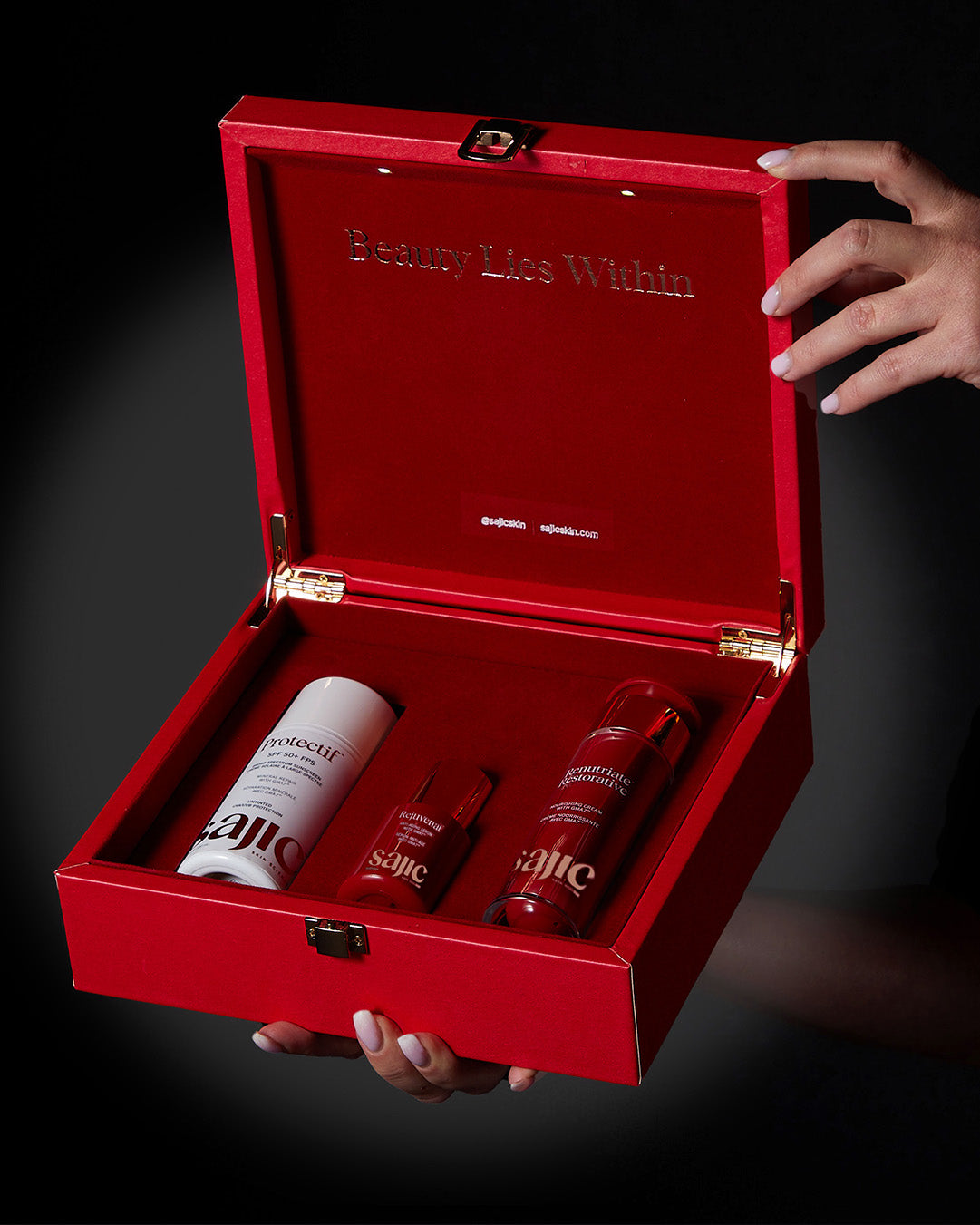
Topicals won't surgically lift, but the right actives measurably improve firmness, thickness, and texture over months. Retinoids increase dermal collagen — see retinol vs retinaldehyde vs retinoic acid for choosing one; peptides support the skin's repair signalling; and a strong barrier keeps skin plump and resilient rather than thin and crepey. If retinoids are too irritating, bakuchiol is a gentler collagen-supportive alternative. Rejuvenat pairs retinaldehyde with peptides and ceramides for this remodeling window, and Renutriate offers a bakuchiol and niacinamide route for skin that does not tolerate retinoids.
Protect against the biggest accelerator: UV
Sun exposure degrades collagen and elastin — precisely the fibres you're trying to preserve. Daily mineral SPF is non-negotiable during and after weight loss. Protectif® mineral SPF 50+ adds photolyase to help repair existing UV-induced DNA damage while blocking new damage.
In-office devices and, when needed, surgery
For mild-to-moderate laxity, energy-based treatments — radiofrequency, microneedling with radiofrequency, and ultrasound-based tightening — stimulate collagen and can produce modest firming under a qualified provider. For significant hanging skin after major weight loss, body-contouring surgery is the only definitive solution, and no topical or device replaces it. A dermatologist can help you set realistic expectations and sequence these options.
Which energy-based devices actually help?
The realistic options for mild-to-moderate laxity
For skin that's loose but not truly excess, in-office energy devices can produce modest, gradual firming by heating the dermis and stimulating new collagen. The main categories are radiofrequency (RF), which heats the dermis to trigger collagen contraction and remodeling; microneedling with radiofrequency, which adds controlled micro-injury for a stronger collagen response; and ultrasound-based tightening, which delivers focused energy to deeper support layers. Results are real but incremental — think firmer, smoother, better-quality skin over months, not a surgical lift.
Setting expectations
Energy devices work best on early, mild-to-moderate laxity in patients with reasonable baseline skin quality, and they usually require a series of treatments plus maintenance. They will not remove hanging skin, and marketing that implies a "non-surgical facelift" oversells them. Used realistically and under a qualified provider, they're a solid middle option between topicals and surgery.
Do you need surgery? A simple candidacy framework
Matching the option to the severity
A useful way to think about it: mild laxity (skin looks slightly less firm, no true excess) responds best to the foundational plan — muscle preservation, retinoids, peptides, barrier repair, and daily SPF, optionally with an energy device. Moderate laxity (visible looseness, some crepiness, but skin still largely conforms) is where energy-based devices earn their place alongside the topical routine. Significant excess skin — folds that hang, chafe, or don't retract at all after major weight loss — is a surgical problem, and body-contouring procedures (such as abdominoplasty, brachioplasty, or a lower-body lift) are the only definitive solution.
Why skincare still matters at every level
Even patients heading for surgery benefit from optimising skin quality first: healthier, better-hydrated, photoprotected skin heals better and holds results longer. Skincare isn't competing with devices or surgery — it's the foundation that makes each of them perform better.
Do different body areas behave differently?
Yes — and it changes the plan. The face shows loss first and responds relatively well to topicals, energy devices, and volume support because the skin is thin and the interventions are well developed (start with our Ozempic face before-and-after guide). The neck and jawline are intermediate — often helped by energy devices plus disciplined skincare. The abdomen, upper arms, and inner thighs carry the most skin and take the longest, most-stretched history, so they retract the least; after major weight loss these are the areas most likely to need surgical contouring rather than topical or device treatment. Matching your expectations to the area — aggressive optimism for the face, realism for the trunk and limbs — prevents both wasted spending and disappointment.
What's a realistic timeline — and what does "better" look like?
Skin remodeling is slow. Improvements from topicals and muscle work typically show over 3 to 6 months and continue building toward 12 to 24 months; energy-device results accrue over a similar multi-month window as new collagen forms. "Better" here means quality: firmer, smoother, thicker, more even skin that ages well at your new weight — not the surgical removal of excess. Naming that distinction upfront is what separates an honest plan from the products and clinics that promise to "erase" loose skin. Set the expectation correctly and the results — real firming, better texture, more resilient skin — are genuinely satisfying.
Frequently asked questions
Can loose skin tighten on its own?
Mild laxity, especially in younger skin, can improve gradually over 6–24 months as the skin remodels — helped considerably by muscle preservation, sun protection, and collagen-supportive care. Significant excess skin after large weight loss generally will not fully retract on its own.
Does collagen powder or supplements help sagging skin?
Evidence for oral collagen improving skin elasticity is mixed and modest at best; it is not a substitute for adequate total protein, resistance training, and topical collagen stimulation. Prioritise overall protein and a proven topical retinoid before spending on collagen powders.
Is loose skin from GLP-1 weight loss different from other weight loss?
The skin biology is the same — it comes down to how far skin stretched and how fast the fat left. GLP-1 medications simply tend to produce faster loss, which can leave less time for gradual retraction. The prevention levers are identical.
What's the single most effective thing I can do?
Lose weight at a steady, physician-guided pace while eating enough protein and doing resistance training. Skin that loses fat gradually, over supported muscle, with daily sun protection, ends up in far better condition than skin that lost weight quickly and unsupported.
The bottom line
Loose skin after weight loss is manageable, and much of the outcome is still in your hands even after you've started losing. Pace the loss, protect muscle with protein and training, stimulate collagen with retinoids and peptides, and defend it all with daily mineral SPF. Skincare like Renutriate®, Rejuvenat®, and Protectif® optimises skin quality and firmness; devices and, for major excess skin, surgery are the definitive tightening tools when they're needed.
If your main concern is the face specifically, start with the Ozempic face prevention guide and the before-and-after breakdown. Whatever the drug or the method, the biology — and the plan — is the same.
References
- Fisher GJ, Kang S, Varani J, et al. Mechanisms of photoaging and chronological skin aging. Archives of Dermatology. 2002;138(11):1462-1470. doi.org/10.1001/archderm.138.11.1462
- Wilding JPH, Batterham RL, Calanna S, et al. Once-weekly semaglutide in adults with overweight or obesity. New England Journal of Medicine. 2021;384(11):989-1002. doi.org/10.1056/NEJMoa2032183
- Jastreboff AM, Aronne LJ, Ahmad NN, et al. Tirzepatide once weekly for the treatment of obesity. New England Journal of Medicine. 2022;387(3):205-216. doi.org/10.1056/NEJMoa2206038
- Wharton S, Davies M, Dicker D, et al. Managing the gastrointestinal side effects of GLP-1 receptor agonists in obesity. Nature Reviews Endocrinology. 2022;18(2):112-124. doi.org/10.1038/s41574-021-00605-y
- Krutmann J, Bouloc A, Sore G, Bernard BA, Passeron T. The skin aging exposome. Journal of Dermatological Science. 2017;85(3):152-161. doi.org/10.1016/j.jdermsci.2016.09.015
This article is for informational purposes only and does not constitute medical advice. Always consult a qualified physician or dermatologist for individual guidance on weight loss and skin treatments.
About the author
Dr. Dusan Sajic, MD, PhD, FRCPC, FAAD is a board-certified dermatologist with 22+ years of clinical experience, Past President of CLASS (Canadian Laser and Aesthetic Specialists Society), TEDx speaker, and inventor of GMA7® (Genoplex Microdelivery Activator). He founded Sajic Skin Science in 2007 and writes on dermatology, longevity, and evidence-based skincare. Meet Dr. Sajic →


