



How do you get rid of dark spots on your face?
The honest first answer is that it depends what kind of dark spot you have, and most articles on this topic skip that step entirely. Sun spots, post-acne marks, and melasma look similar in the mirror and respond very differently to treatment. One of them can be made permanently worse by the laser that clears another.
What every type has in common is the foundation: daily sun protection, a pigment-blocking active used consistently, and patience measured in months rather than weeks. What differs is which active, whether a procedure is safe, and how likely the spot is to come back.
First, work out which kind of dark spot you have
Sun spots, also called solar lentigines
Flat, well-defined tan or brown patches on the areas that catch the most light: cheekbones, forehead, nose, backs of the hands. They accumulate with lifetime UV exposure and tend to appear from the forties onward. These are the most straightforward to treat and the least likely to return, provided you protect the skin afterward.
Post-inflammatory hyperpigmentation
The flat brown or grey mark left behind after a pimple, a scratch, or any inflammation. It is not a scar. It is pigment produced in response to the injury, and it fades on its own eventually, though eventually can mean six months to a year without help (Callender et al., 2011). It is more common and more persistent in deeper skin tones. The critical point is that picking at the original spot deepens and prolongs the mark.
Melasma
Larger, symmetrical grey-brown patches, usually across the cheeks, upper lip and forehead. Hormones drive it, so pregnancy and oral contraceptives are common triggers, and visible light plays a role alongside UV (Passeron and Picardo, 2018). Melasma is chronic and relapsing rather than curable, and it is the one type where aggressive treatment often backfires. We cover it in depth in the melasma treatment guide.
When it is not a dark spot at all
A pigmented spot that is asymmetric, has an irregular or blurred border, contains more than one color, is larger than about six millimetres, or is changing in any way should be examined by a physician. Skin cancer can present as a new or changing pigmented lesion, and no topical product is an appropriate response to that. This is worth a same-month appointment, not a wait-and-see.

Sunscreen first, and it is not optional
Every dark spot is a pigment cell responding to a signal, and UV is the loudest signal there is. Treating pigment without daily protection is like bailing a boat without patching the hole. A broad-spectrum SPF 30 or higher, applied every morning and reapplied with sun exposure, is the difference between a treatment that works and one that plateaus.
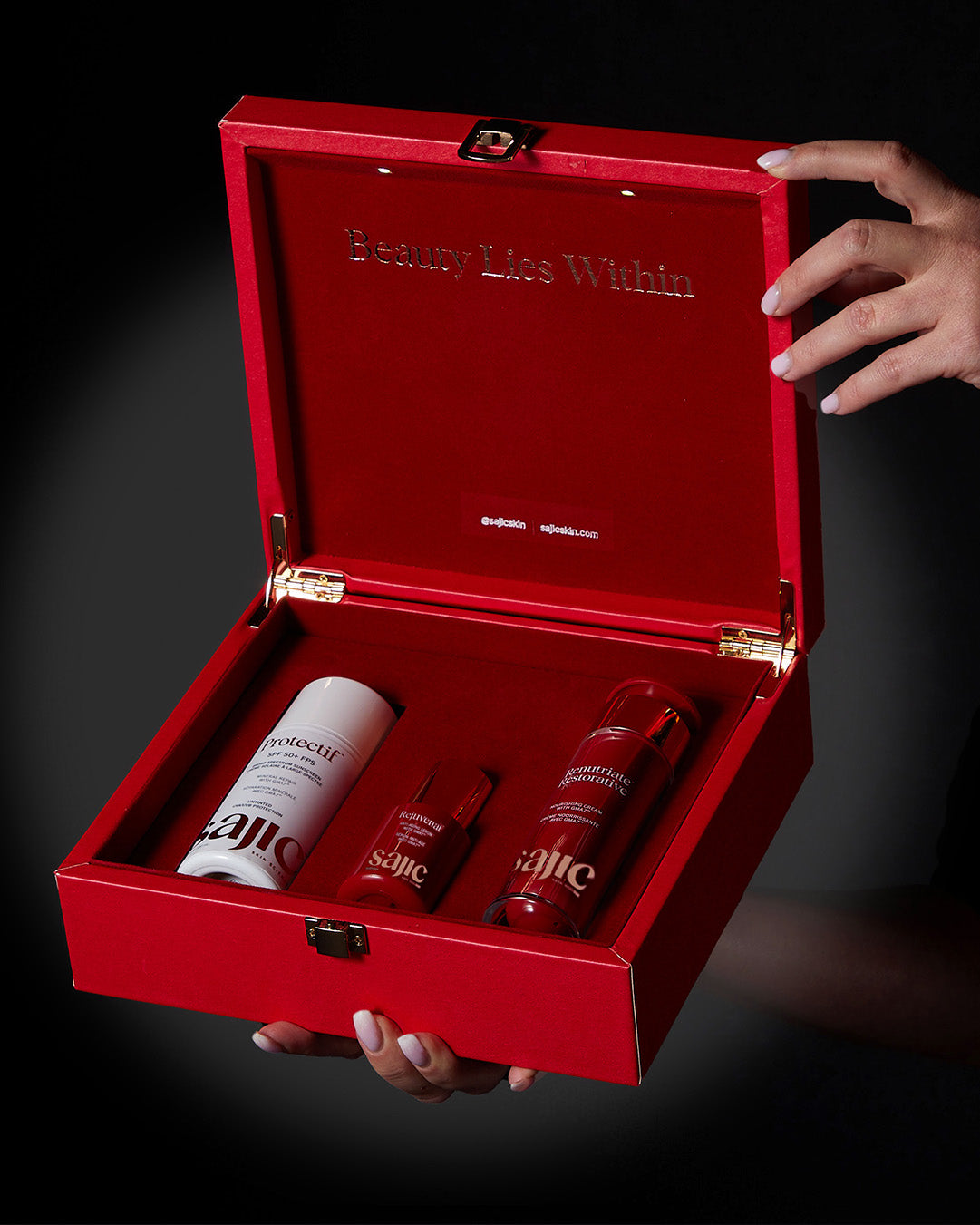
For melasma specifically, standard sunscreen is not enough, because visible light also drives it. Tinted mineral formulas containing iron oxides block the visible wavelengths that clear sunscreens let straight through, and they outperform non-tinted formulas for melasma control (Boukari et al., 2015). Protectif is built on zinc oxide and titanium dioxide with iron oxide and adds photolyase for repair of existing UV damage. Browse our tinted mineral sunscreens and sunscreens for dark skin.
The actives that actually fade pigment
Blocking pigment production
Most brightening ingredients interfere with tyrosinase, the enzyme that produces melanin. Vitamin C is the most familiar, and our comparison of vitamin C serums covers which forms are worth buying. Azelaic acid is a strong option and is considered safe in pregnancy. Kojic acid and cysteamine round out the category. Hydroquinone remains the most studied of all, but it is used in structured courses with breaks rather than indefinitely, and in many countries it requires a prescription.
Blocking pigment transfer
Niacinamide works on a different step. It leaves melanin production alone and reduces the handoff of pigment from melanocytes to surrounding skin cells (Hakozaki et al., 2002). Because the mechanism differs from the tyrosinase inhibitors, it layers with them rather than duplicating them, which is why so many pigment routines include both.
Speeding up turnover
Retinoids accelerate how quickly pigmented cells move up and off the surface, and they improve penetration of everything else you apply. They are a standard part of pigment treatment for that reason. If you are choosing one, our guide to retinol, retinaldehyde and retinoic acid explains the differences. Rejuvenat combines retinaldehyde with niacinamide and stabilized vitamin C, which covers turnover, transfer and production in a single step.
Procedures, and when to be careful
Chemical peels and laser treatments can clear sun spots efficiently in the right hands. The caution is specific and important. Melasma is prone to rebound after aggressive energy-based treatment, sometimes leaving the patient worse than before, so conservative low-energy approaches are the standard there if devices are used at all. Deeper skin tones carry a higher risk of post-inflammatory hyperpigmentation from any procedure that causes significant inflammation, which means the treatment can create the exact problem it was meant to solve.
The practical rule: sun spots in lighter skin are the most forgiving case for procedures, and melasma in deeper skin is the least. Anything beyond topicals is worth a consultation rather than a groupon.
How long will it take?
Post-acne marks are usually the fastest, often visibly better in two to three months with a consistent routine. Sun spots take three to six months with topicals alone, and faster with a procedure. Melasma improves over three to six months and then requires ongoing maintenance, because stopping treatment and sun protection almost always brings it back.
Across all of them, the mistake that costs the most time is switching products every few weeks. Pigment routines are slow by nature, and you cannot tell whether something is working until you have given it at least twelve weeks.
Preventing the next round
Fading a spot and preventing the next one are the same job done at different times, and prevention is the cheaper half. Three habits do most of the work.
Wear sunscreen daily and reapply it when you are outdoors for any length of time, because the pigment cells that made the spot you are treating are still there and still responsive. Add physical shade where you can: a wide-brimmed hat does more for the cheekbones and nose than any additional serum. And treat inflammation early. Since post-inflammatory marks are pigment produced in response to injury, controlling acne quickly and resisting the urge to pick prevents marks that would otherwise take months to fade.
For anyone whose pigment is hormonally driven, it is worth raising oral contraceptives and hormone therapy with your physician. Neither has to be stopped, but knowing that a medication is contributing changes what is realistic to expect from topical treatment and helps you plan around predictable flares.
Frequently asked questions
What is the fastest way to fade dark spots?
For sun spots, an in-office laser or peel from a qualified provider is faster than any topical. For post-acne marks and melasma, faster is not usually better, since aggressive treatment can worsen both. The reliable route is daily sunscreen plus a consistent combination of a tyrosinase inhibitor, niacinamide and a retinoid, judged at twelve weeks rather than at three.
Do dark spots come back after treatment?
Sun spots can return with further sun exposure but generally stay away with good protection. Post-acne marks return only if new breakouts appear. Melasma relapses in most people if treatment and sun protection stop, which is why it is described as controlled rather than cured.
Can I use vitamin C and niacinamide together for dark spots?
Yes, and it is a sensible pairing because they work on different steps of pigment formation. The old advice that they cancel each other out comes from laboratory conditions that do not apply to skin. Apply the thinner product first and let it absorb before the next.
Will dark spots fade on their own?
Post-inflammatory marks usually do, though it can take six months to a year. Sun spots rarely fade meaningfully without treatment and tend to accumulate. Melasma fluctuates with hormones and light exposure and does not resolve on its own. In all three cases, daily sun protection speeds things up and prevents new pigment.
The bottom line
Start by working out which kind of dark spot you are treating, because that decides everything else. Wear mineral sunscreen every day without exception, use a tyrosinase inhibitor such as vitamin C alongside niacinamide, add a retinoid for turnover, and give the routine three months before you judge it.
Be conservative with lasers if you have melasma or a deeper skin tone, and get any changing or irregular spot checked by a physician rather than treating it yourself.
References
- Callender VD, St Surin-Lord S, Davis EC, Maclin M. Postinflammatory hyperpigmentation: etiologic and therapeutic considerations. American Journal of Clinical Dermatology. 2011;12(2):87-99. doi.org/10.2165/11536930-000000000-00000
- Hakozaki T, Minwalla L, Zhuang J, et al. The effect of niacinamide on reducing cutaneous pigmentation and suppression of melanosome transfer. British Journal of Dermatology. 2002;147(1):20-31. doi.org/10.1046/j.1365-2133.2002.04834.x
- Passeron T, Picardo M. Melasma, a photoaging disorder. Pigment Cell & Melanoma Research. 2018;31(4):461-465. doi.org/10.1111/pcmr.12684
- Boukari F, Jourdan E, Fontas E, et al. Prevention of melasma relapses with sunscreen combining protection against UV and visible light. Journal of the American Academy of Dermatology. 2015;72(1):189-190. doi.org/10.1016/j.jaad.2014.08.023
- Rodrigues M, Pandya AG. Melasma: clinical diagnosis and management options. Australasian Journal of Dermatology. 2015;56(3):151-163. doi.org/10.1111/ajd.12290
This article is for informational purposes only and does not constitute medical advice. A new, changing or irregular pigmented spot should be assessed by a physician. Always consult a qualified dermatologist for guidance on your own skin.
About the author
Dr. Dusan Sajic, MD, PhD, FRCPC, FAAD is a board-certified dermatologist with 22+ years of clinical experience, Past President of CLASS (Canadian Laser and Aesthetic Specialists Society), TEDx speaker, and inventor of GMA7 (Genoplex Microdelivery Activator). He founded Sajic Skin Science in 2007 and writes on dermatology, longevity, and evidence-based skincare. Meet Dr. Sajic


