



How do you fix Ozempic face?
There is no single "fix" for Ozempic face — but there is a clear, layered plan that works, and most of it you can start today. The honest framing matters: skincare and habits rebuild skin quality (firmness, texture, barrier), while a physician addresses lost volume through dose pacing and, when needed, biostimulators or filler. Anyone selling a cream that "reverses" Ozempic face is overpromising. What actually works is a sequence — pace the weight loss, protect muscle, rebuild skin with the right topicals, and use in-office volume support strategically — layered in the right order (Rohrich and Pessa, 2007; Fitzgerald and Vleggaar, 2011).
This guide lays out that plan step by step, what to realistically expect, and how to sequence it so you're not wasting money or time.
Can you actually fix Ozempic face?
What "fixed" realistically means
"Fixed" doesn't mean returning to your pre-weight-loss face — it means a face that looks firm, healthy, and rested at your new, lower weight, without the drawn, hollow, prematurely aged look. That outcome is achievable for most people. The two failure modes are (1) relying on skincare alone to restore volume it can't, and (2) jumping straight to aggressive filler while ignoring skin quality and dose pacing. Avoid both and the results are genuinely good.
Quality vs. volume — the distinction that drives the whole plan
Every intervention slots into one of two buckets. Skin quality — firmness, thickness, texture, barrier — is improved by habits and topicals. Volume — the fat and structural support that deflated — is addressed by a physician with biostimulators or filler. Knowing which bucket a given step serves is what keeps you from overspending on the wrong thing. For the underlying "why," see what's actually happening in the before-and-after.
Step 1: Pace the weight loss and protect muscle
The most effective "treatment" is upstream. The rate of weight loss is the biggest predictor of how severe Ozempic face becomes, so physician-guided dose titration that keeps loss steady — rather than as fast as possible — gives the face months to adapt structurally (Wilding et al., 2021; Jastreboff et al., 2022). Alongside that, protein and muscle preservation keep the scaffold under your skin intact: aim for roughly 1.2–1.6 g of protein per kg per day plus resistance training two to three times weekly (Wharton et al., 2022). These two habits cost nothing extra and change the outcome more than any product. If you take one thing from this article, it's this step.
Step 2: The topical routine that rebuilds skin quality
The three jobs of the routine
An effective GLP-1 skincare routine does exactly three things: stimulate collagen, repair the barrier, and prevent UV damage. Each maps to a specific active category, and skipping any one leaves a gap.
Collagen: a well-tolerated retinoid
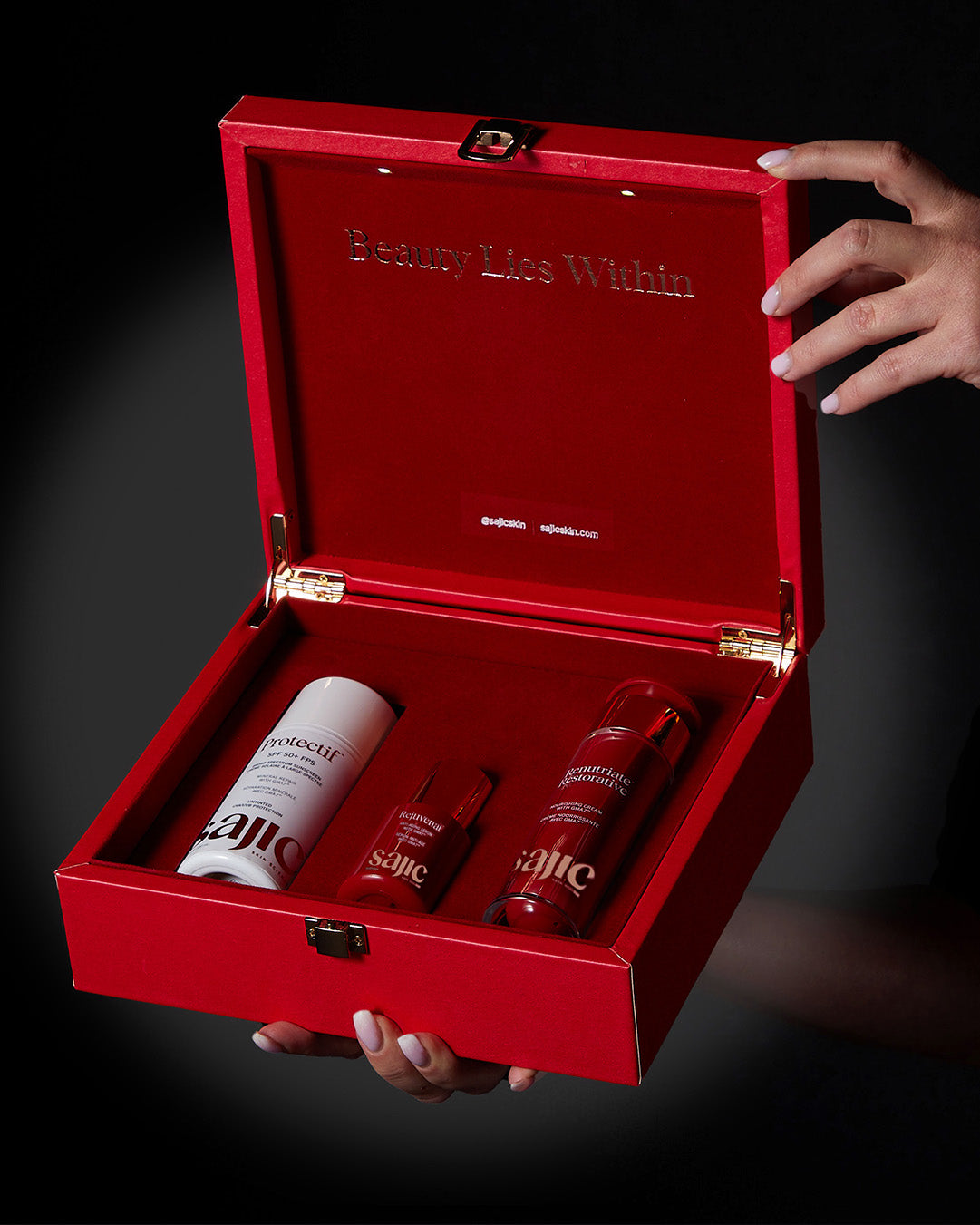
Retinoids are the most evidence-backed topical for stimulating dermal collagen. Retinaldehyde is the practical sweet spot — far more potent than retinol, far gentler than prescription tretinoin (see retinol vs retinaldehyde vs retinoic acid). Sajic Rejuvenat® is built on retinaldehyde plus five peptides in the GMA7® delivery system for this exact purpose. If retinoids irritate your skin, bakuchiol is a gentler collagen-supportive alternative.
Resilience: peptides and barrier repair
Rapid weight loss and caloric restriction stress the skin barrier, leaving it thinner and more prone to a crepey look. A ceramide moisturizer keeps the barrier intact and the skin plump rather than papery, which is the difference between skin that looks deflated and skin that looks firm at lower volume. Rejuvenat carries ceramides and peptides alongside its retinaldehyde, so for many people it covers both jobs.
Protection: daily mineral SPF with DNA repair
UV light degrades exactly the collagen and elastin you're working to preserve, so daily sunscreen is non-negotiable. Protectif® mineral SPF 50+ adds photolyase to help repair existing UV-induced DNA damage while blocking new damage. For patients who want the full routine in one step, the Repair and Protect set pairs Rejuvenat and Protectif together.

Step 3: In-office volume support — and how to choose
Biostimulators: rebuild your own collagen
Poly-L-lactic acid and calcium hydroxylapatite stimulate your fibroblasts to lay down new collagen over 4–6 months, rebuilding structural support rather than simply filling (Fitzgerald and Vleggaar, 2011). Started before or during significant loss, they can offset volume you're about to lose; even started later they restore structure gradually and naturally. For most patients over 40, this is the highest-value in-office step.
Filler: fast, targeted volume
Hyaluronic-acid filler restores specific hollows quickly — temples, cheeks, under-eyes. It's the fastest visual fix but is reactive and temporary, and over-filling a slim face looks unnatural. Used judiciously and in coordination with the rest of the plan, it's effective; used as a lone solution, it disappoints.
Energy devices: firming, not volume
Radiofrequency, RF-microneedling, and ultrasound-based tightening stimulate collagen for modest firming of mild-to-moderate laxity. They complement the topical routine and are best viewed as skin-quality tools, not volume restoration.
What order should you do these in?
Sequence beats intensity. A sensible order for most people: (1) from day one, pace the weight loss with your physician and lock in protein and resistance training; (2) start the topical routine — retinoid, barrier repair, mineral SPF — at initiation, not after the change shows; (3) if you're over 40 or losing quickly, plan biostimulators early with a qualified provider; (4) reserve filler for specific residual hollows once weight stabilises; (5) add energy devices for lingering laxity. Doing them in this order means each step supports the next and you rarely pay for aggressive correction you could have prevented.
How fast will you see results?
Habits and topicals improve skin quality over 8–12 weeks, with collagen-driven firmness continuing to build for 3–6 months. Biostimulators show over 4–6 months as new collagen forms; filler is immediate. The pattern is clear: the earlier you start the quality work, the less corrective volume work you'll need — which is why "start now" is the single best piece of advice for anyone on or starting a GLP-1.
Frequently asked questions
What's the fastest way to fix Ozempic face?
Fastest visible volume: hyaluronic-acid filler under a qualified injector. But "fastest" and "best" differ — filler alone ignores skin quality and dose pacing, so results look less natural and don't last. The best outcomes come from the layered plan, with filler used selectively rather than as the whole answer.
Can I fix Ozempic face without fillers or surgery?
You can meaningfully improve skin quality — firmness, texture, resilience — without injectables, through dose pacing, protein and muscle work, and a proper topical routine. What topicals cannot do is restore significant lost volume; for that, biostimulators or filler are the tools. Many people are happy with the quality-focused plan alone; others add volume support for hollows.
Which products should I use for Ozempic face?
The core routine is a retinoid for collagen (such as Rejuvenat, which also contains peptides and ceramides), a barrier-supporting moisturizer, and a daily mineral SPF (such as Protectif). If retinoids irritate your skin, Renutriate uses bakuchiol instead. The categories matter more than any single brand: collagen stimulation, barrier support and photoprotection, used consistently.
Should I stop my GLP-1 to fix my face?
No. Stopping or regaining weight to restore facial volume trades your metabolic health for appearance and often doesn't fully work, since stretched skin doesn't always retract. The goal is to preserve your face while continuing effective treatment, with physician-guided pacing and coordinated skin care.
The bottom line
Fixing Ozempic face isn't one product or one procedure — it's a sequence: pace the weight loss, protect muscle, rebuild skin quality with a retinoid, barrier repair, and mineral SPF, then add physician-guided volume support where it's needed. Skincare handles quality; your physician handles volume; done in the right order, they produce a face that looks firm and healthy at your new weight.
Start the quality work today — the earlier you begin, the less correction you'll need. The topical core is simple to begin: Rejuvenat for collagen and Protectif for protection, available together in the Repair and Protect set. For the full context, read the Ozempic face prevention guide and, if laxity is your main concern, loose and sagging skin after weight loss.
References
- Rohrich RJ, Pessa JE. The fat compartments of the face: anatomy and clinical implications for cosmetic surgery. Plastic and Reconstructive Surgery. 2007;119(7):2219-2227. doi.org/10.1097/01.prs.0000265403.66886.54
- Fitzgerald R, Vleggaar D. Facial volume restoration of the aging face with poly-L-lactic acid. Aesthetic Surgery Journal. 2011;31(6):680-686. doi.org/10.1177/1090820X11418612
- Wilding JPH, Batterham RL, Calanna S, et al. Once-weekly semaglutide in adults with overweight or obesity. New England Journal of Medicine. 2021;384(11):989-1002. doi.org/10.1056/NEJMoa2032183
- Jastreboff AM, Aronne LJ, Ahmad NN, et al. Tirzepatide once weekly for the treatment of obesity. New England Journal of Medicine. 2022;387(3):205-216. doi.org/10.1056/NEJMoa2206038
- Wharton S, Davies M, Dicker D, et al. Managing the gastrointestinal side effects of GLP-1 receptor agonists in obesity. Nature Reviews Endocrinology. 2022;18(2):112-124. doi.org/10.1038/s41574-021-00605-y
This article is for informational purposes only and does not constitute medical advice. Injectable and prescription treatments require assessment by a qualified provider. Always consult a physician or dermatologist for individual guidance.
About the author
Dr. Dusan Sajic, MD, PhD, FRCPC, FAAD is a board-certified dermatologist with 22+ years of clinical experience, Past President of CLASS (Canadian Laser and Aesthetic Specialists Society), TEDx speaker, and inventor of GMA7® (Genoplex Microdelivery Activator). He founded Sajic Skin Science in 2007 and writes on dermatology, longevity, and evidence-based skincare. Meet Dr. Sajic →


