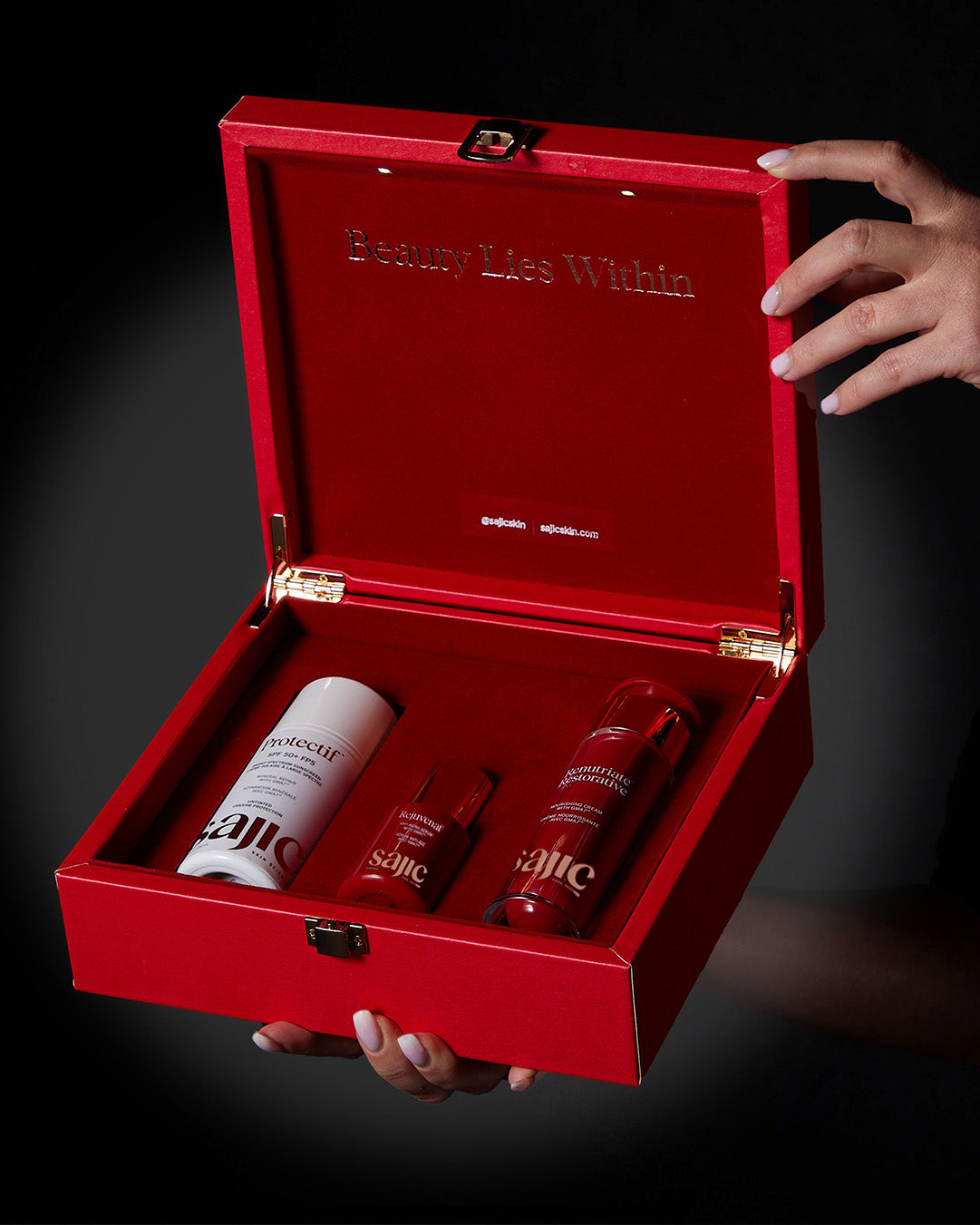




Dr. Dusan Sajic, the dermatologist behind Sajic Skin, was featured in Luxury Travel Magazine in an October 2026 piece on travel and skin health. That piece is about the bigger picture. This guide covers the practical questions: the plane, the carry-on bag and the beach.
Do you need sunscreen on a plane? The short answer
In the cabin of a commercial airliner, probably not much, on the evidence so far. UV rises with altitude, but a 2017 study that took measurements on 14 daytime flights detected no UVA or UVB anywhere in the passenger cabins it tested. It is a single study and cockpit windows vary between aircraft, so closing the shade on a long daytime flight with the sun on your side is a sensible, free precaution. The sunscreen you pack matters most once you land.
Are plane windows UV protected?
Largely, on the evidence we have, though it depends on the window. Outside the aircraft, UV is stronger than on the ground. The World Health Organization notes that UV levels increase with altitude, because thinner air absorbs less of it, and an Austrian monitoring network reported in 2019 that, across its ground and mountain stations, UVA rose by 8% to 9% for every 1,000 metres.
The windows are what stand between that and you. The European Cockpit Association, which represents pilots, says cockpit windows generally block UVB, the main cause of sunburn, while UVA transmission varies by aircraft type and even by window position. UVA is the part of sunlight associated with tanning, pigmentation and premature aging, which is why it matters for skin even when it does not burn.
A 2015 study measured the pilot's seat of a small turboprop, not an airliner. Sanlorenzo and colleagues found that 56.6 minutes at 30,000 feet behind its acrylic windshield delivered the same UVA dose, weighted for cancer risk, as a 20-minute session in a UVA-only tanning bed.
Measurements in airliner cabins point the other way. Cadilhac and colleagues took readings on 14 commercial flights in 2016, in daylight at cruising altitude, and detected neither UVA nor UVB in any part of the cabins tested, or in the Airbus cockpits. They did find UVA in Boeing 777 cockpits, at levels well below those on the ground, and the cockpit sun visors cut it by more than ten times. Pilots and cabin crew do have about twice the melanoma incidence of the general population, according to a 2015 meta-analysis, but the authors of the cabin study concluded that this may not be related to in-flight UV. These are small studies, and they do not settle it.
The practical answer is small. On a long daytime flight, if the sun is on your side, close the shade. Save the sunscreen for where you are going.
Can you bring sunscreen through airport security?
Yes, within the liquids limit. The US Transportation Security Administration allows sunscreen in carry-on bags in containers of 3.4 oz (100 ml) or less, inside a quart-sized bag. Checked bags are allowed too, within FAA limits of 500 ml (17 fl oz) per container and 2 L (68 fl oz) per person. The TSA also notes that the final decision rests with the officer at the checkpoint.
In Canada, CATSA sets the same 100 ml/100 g (3.4 oz) limit per container, and all of your containers have to fit in one clear, resealable bag of no more than 1 L. Larger containers can go in checked baggage.
Protectif's 30 ml size sits well inside those limits, which leaves room in the bag for everything else.
What should go in a travel skin care kit?
Keep it small, and pack nothing new. The kit that works is the routine you already use, plus sun protection.
- A broad-spectrum sunscreen with an SPF of 30 or higher. That is Health Canada's recommendation. Protectif is an SPF 50+ mineral sunscreen with zinc oxide and titanium dioxide.
- A tinted version if you have melasma. The American Academy of Dermatology says visible light can worsen melasma and recommends a tinted sunscreen that contains iron oxide. Protectif comes in Fair Tint and Deep Tint.
- A lip balm with SPF 30 or higher, as the Canadian Dermatology Association recommends.
- The moisturizer you already use. The Aerospace Medical Association puts cabin humidity at around 20%, which can dry the skin of sensitive travellers.
- A wide-brimmed hat and sunglasses for the destination.
Leave new products at home. Health Canada suggests testing a new sunscreen on the inner forearm and checking for a reaction after 48 hours, and that is much easier to do a week before you fly than on the first morning of a holiday. The Sajic Beauty Bag keeps the kit together.

How much sunscreen do you need, and how often?
Health Canada's guide is about 1 teaspoon for the face and neck, and about 7 teaspoons (35 mL) to cover an adult's exposed skin. Applying less than the recommended amount greatly reduces the protection you get.
Put it on at least 15 minutes before you go out, and reapply at least every 2 hours. Reapply sooner if you are sweating, swimming or towelling off. Health Canada also says a "water resistant" sunscreen still needs reapplying after you get out of the water. Protectif is not labelled water resistant, so for swimming use a water-resistant body sunscreen, and reapply Protectif to your face once you are out of the water and dry.
The number on the bottle does not buy you time. Health Canada points out that SPF 30 does not mean you can stay in the sun 30 times longer, and that UV rays are strongest between 10 a.m. and 3 p.m.
Look after the bottle as well. Health Canada says extreme heat can make sunscreen less effective, so keep it out of direct sun and hot cars, and check the expiry date before you pack last year's tube.
How do you look after your skin after a day in the sun?
If you burned, start with the basics. The American Academy of Dermatology suggests cool showers, a moisturizer with aloe vera or soy, and extra water, because a sunburn draws fluid to the skin's surface. Do not pop blisters. They mean a second-degree burn, and they protect the skin while it heals.
Health Canada advises getting medical attention right away for a sunburn that forms blisters or is extremely painful, or that comes with nausea, fever or severe chills.
If you did not burn, keep your evening routine the same as at home. If Rejuvenat is already part of it, it pairs photolyase, which a 2019 review describes as a DNA repair enzyme, with peptides. Our article on photolyase explains what that enzyme does and what the research shows. If you have had a laser treatment or peel recently, our post-procedure recovery protocol covers sun protection while skin heals.
Frequently asked questions
Can you get sunburned through a plane window?
Unlikely. A study on 14 commercial flights found no UVB or UVA in the passenger cabins it tested, and cockpit windows generally block UVB, the main cause of sunburn. UVA has been measured through some cockpit windows, and UVA is associated with tanning, pigmentation and premature aging. On a long daytime flight with the sun on your side, closing the shade is the simplest fix.
Can you bring sunscreen on a plane in your carry-on?
Yes, in containers of 100 ml (3.4 oz) or less. That is the rule at US airports under the TSA, which asks for a quart-sized bag, and at Canadian airports under CATSA, where every container has to fit in one clear, resealable bag of no more than 1 L. Larger bottles go in checked baggage (in the US, up to 500 ml per container).
Is SPF 50 better than SPF 30 for travel?
Health Canada recommends a broad-spectrum SPF of 30 or higher, so both meet the guideline. A higher number is not a licence to stay out longer: Health Canada notes that SPF 30 does not mean 30 times longer in the sun. How much you apply, and how often you reapply, matter as much as the number.
Do you need sunscreen on a cloudy beach day?
Yes. The Canadian Dermatology Association notes that most of the sun's rays can penetrate light cloud cover, and Health Canada advises protecting your skin even on cloudy days. Water and light-coloured sand also reflect UV, which adds to what reaches you on the beach.
References
- Luxury Travel Magazine. How Dr. Dusan Sajic Is Changing the Way Luxury Travelers Think About Skin Health. October 7, 2026. Retrieved 2026-10-13. luxurytravelmagazine.com
- World Health Organization. Ultraviolet radiation (fact sheet). Retrieved 2026-10-13. who.int
- European Cockpit Association. Protecting Pilots Against UV-A Radiation (position paper). Retrieved 2026-10-13. eurocockpit.eu
- Sanlorenzo M, Vujic I, Posch C, Cleaver JE, Quaglino P, Ortiz-Urda S. The risk of melanoma in pilots and cabin crew: UV measurements in flying airplanes. JAMA Dermatology. 2015;151(4):450-452. Retrieved 2026-10-13. PMC4476387
- Sanlorenzo M, Wehner MR, Linos E, et al. The risk of melanoma in airline pilots and cabin crew: a meta-analysis. JAMA Dermatology. 2015;151(1):51-58. Retrieved 2026-10-13. PubMed 25188246
- Cadilhac P, Bouton MC, Cantegril M, Cardines C, Gisquet A, Kaufman N, Klerlein M. In-flight ultraviolet radiation on commercial airplanes. Aerospace Medicine and Human Performance. 2017;88(10):947-951. Retrieved 2026-10-13. PubMed 28923144
- Schmalwieser AW, Klotz B, Schwarzmann M, et al. The Austrian UVA-Network. Photochemistry and Photobiology. 2019;95(5):1258-1266. Retrieved 2026-10-13. PubMed 31017671
- Transportation Security Administration. Liquids, Aerosols, and Gels Rule. Retrieved 2026-10-13. tsa.gov
- Transportation Security Administration. Sunscreen (What Can I Bring?). Retrieved 2026-10-13. tsa.gov
- Canadian Air Transport Security Authority. Liquids, Non-solid Food & Personal Items. Retrieved 2026-10-13. catsa-acsta.gc.ca
- Health Canada. Sunscreens. Retrieved 2026-10-13. canada.ca
- Health Canada. First aid advice for sunburn and heat illness. Retrieved 2026-10-13. canada.ca
- American Academy of Dermatology. Melasma: Self-care. Retrieved 2026-10-13. aad.org
- American Academy of Dermatology. How to treat sunburn. Retrieved 2026-10-13. aad.org
- Environment and Climate Change Canada. Ultraviolet (UV) index and sun safety. Retrieved 2026-10-13. canada.ca
- Canadian Dermatology Association. Sun Safety for Every Day. Retrieved 2026-10-13. dermatology.ca
- Puig S, Granger C, Garre A, et al. Review of clinical evidence over 10 years on prevention and treatment of a film-forming medical device containing photolyase in the management of field cancerization in actinic keratosis. Dermatology and Therapy. 2019;9(2):259-270. Industry-funded. Retrieved 2026-10-13. PubMed 30968311
- Aerospace Medical Association. Health Tips for Airline Travel. Retrieved 2026-10-13. asma.org
This article is for informational purposes only and does not constitute medical advice. Always consult a qualified dermatologist for guidance on your own skin.
Dr. Sajic's longer piece on what a flight does to skin, through a skin longevity lens, is on his own site: What flying does to your skin. His press coverage is listed at drsajic.com/in-the-press.
About the author
Dr. Dusan Sajic, MD, PhD, FRCPC, FAAD is a Royal College-certified dermatologist, a Fellow of the American Academy of Dermatology and an Assistant Clinical Professor at McMaster University. He is the founder of Sajic Skin and writes on dermatology, skin longevity and evidence-based skincare. Meet Dr. Sajic


