



What is crepey skin, and why is it different from wrinkles?
Crepey skin is thin, finely lined skin that looks like crumpled tissue paper. It shows up most often on the neck, chest, upper arms, and under the eyes. The distinction that matters: a wrinkle is a fold in one spot, usually where you move your face, while crepiness is a change in the texture and thickness of the skin across a whole area. That difference determines what works. Filling a line does nothing for crepiness, because the problem is the quality of the skin itself, not a crease in it.
The good news is that crepey skin responds to treatment better than most people expect, because two of its three drivers are things you can still act on today.
What causes crepey skin?
Collagen and elastin decline
Skin gets its firmness from collagen and its snap-back from elastin. Both decline with age, and collagen production in older skin drops measurably compared with younger skin (Varani et al., 2006). As the dermis thins, the surface loses its support and starts to gather into fine lines under its own weight. This is the slow, structural part of the problem, and it is the part that takes months to improve.
Sun exposure does most of the damage
Chronological aging alone produces relatively mild change. What separates crepey skin from smooth skin at the same age is usually accumulated ultraviolet exposure, which degrades collagen and disorganizes elastin far faster than time does (Fisher et al., 2002). You can see this on your own body. Compare the skin on your forearm with the skin on your inner upper arm, where the sun rarely reaches. Same age, same genetics, very different texture.
A dry barrier exaggerates it
Some of what reads as crepiness is dehydration sitting on top of the structural change. When the skin barrier is compromised, water leaves faster than it is replaced, and thin skin with low water content creases at the slightest movement (Rawlings and Harding, 2004). This layer of the problem is the fastest to fix, and it is why a good moisturizer can make a visible difference in a couple of weeks while the deeper work is still underway.

Where does crepey skin show up first?
Almost always the neck and chest, then the upper arms, then under the eyes. There is a reason for that order. Skin in those areas is thinner to begin with, has fewer oil glands to hold moisture, and gets substantial sun exposure that people rarely protect. The chest in particular collects decades of incidental UV through car windows and open collars.
Facial crepiness under the eyes is a slightly different case, since that skin is the thinnest on the body and sits over a area that loses volume with age. If your main concern is looseness rather than texture, the mechanics are covered in our guide to loose and sagging skin, which shares much of the same biology.
What actually firms crepey skin?
A retinoid, for the structural layer
Retinoids remain the best studied topical for stimulating new collagen in the dermis (Mukherjee et al., 2006). They work slowly and they reward consistency. For most people retinaldehyde hits the useful middle ground, since it converts to active retinoic acid in one step rather than two and irritates far less than prescription tretinoin. Our comparison of retinol, retinaldehyde and retinoic acid covers how to choose. If retinoids irritate you, bakuchiol is a gentler alternative with reasonable evidence behind it.
One practical note for the neck and chest: start at half the frequency you use on your face. That skin is thinner and irritates easily, and an angry, inflamed neck sets you back further than a slow start does.
Barrier repair, for the fastest visible change
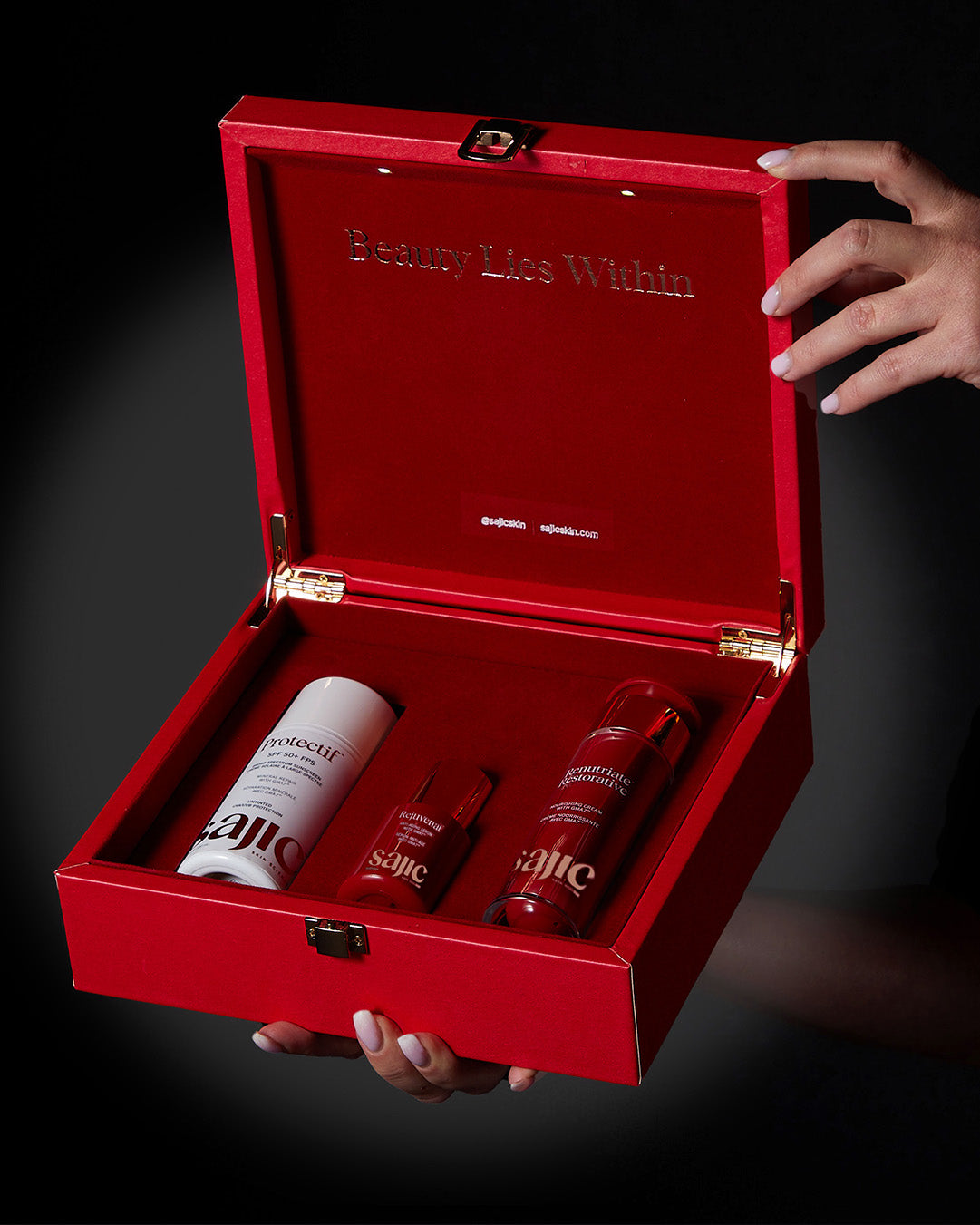
Ceramides, cholesterol and fatty acids replace what a compromised barrier has lost, and they hold water in the upper layers so the surface stops creasing at the slightest movement. Any well-formulated ceramide moisturizer does this job. Rejuvenat carries ceramides and peptides alongside its retinaldehyde, and Renutriate supports the barrier by a different route, with niacinamide and lipids such as phospholipids and plant sterols. Apply it to slightly damp skin and extend everything you use on your face down over the neck and chest, which most people simply forget.
Daily mineral sunscreen, because it is the actual cause
If UV drives most of the damage, then protection is not an optional final step. It is the intervention that stops you from undoing the rest. Daily broad-spectrum mineral SPF on the face, neck and chest is the single habit with the best long-term return. Protectif adds photolyase, an enzyme studied for its role in repairing existing UV-induced DNA damage, which we cover in the photolyase guide.
In-office treatments, for moderate cases
Fractional lasers, radiofrequency and microneedling all stimulate collagen through controlled injury and can produce real improvement in texture over several months. They work best as an addition to a good topical routine rather than a replacement for one, and results on the neck and chest are more modest than on the face. A dermatologist can tell you whether your degree of crepiness justifies the cost.
What does not work
Two things are worth naming plainly. Fillers and neuromodulators address volume and muscle movement, so they do very little for texture, and injecting a thin crepey neck can occasionally make the surface look worse. And drinking more water does not fix crepey skin. Systemic hydration matters for health, but topical water loss is a barrier problem, and you solve it at the barrier.
Body lotions marketed for crepiness are usually fine as moisturizers and rarely contain enough active ingredient to change the dermis. They will help the fast layer of the problem and not the slow one.
How long does it take?
Barrier and hydration improvements show up in two to four weeks. Texture changes from a retinoid generally become visible around twelve weeks, and collagen-driven firmness keeps building for six months or longer. On the neck, chest and arms, add time. Those areas turn over more slowly and consistently lag the face by a month or two.
Set the expectation correctly and the results are satisfying. Expect a surgical result from a cream and you will quit at week six, right before the part that works.
What to look for on a label
Product marketing for crepey skin is unusually vague, so it helps to know what to actually read for. On the structural side, look for a retinoid named in the ingredient list: retinal or retinaldehyde, retinol, or a prescription retinoic acid. If the front of the bottle says "firming" but no retinoid appears in the ingredients, you are buying a moisturizer with good copywriting.
On the barrier side, look for ceramides, cholesterol and fatty acids, plus humectants like glycerin or hyaluronic acid to draw water in. Peptides are a reasonable addition. Packaging matters more than people expect for retinoids specifically, since both retinol and retinaldehyde degrade with light and air. An opaque, airless pump protects the active in a way a clear jar cannot.
Body products deserve the same scrutiny. Most lotions sold for crepey arms and legs are pleasant moisturizers with no active capable of changing the dermis. They will improve the look for a day. They will not change the structure.
Frequently asked questions
Can crepey skin be reversed?
It can be improved substantially but not returned to the skin you had at twenty five. Barrier and hydration changes are quick and quite visible. Structural improvement from retinoids and in-office treatments is real but gradual, and it depends on how much sun damage has accumulated. Prevention from here forward has more leverage than any repair you can buy.
Is crepey skin the same as loose skin?
No. Crepiness is a texture and thickness problem in the skin itself. Looseness is a volume and elasticity problem, where there is more skin than there is tissue underneath to fill it. They often occur together, especially after weight loss, and they need different treatments. Topicals help crepiness more than they help laxity.
Does collagen powder help crepey skin?
The evidence for oral collagen improving skin elasticity is mixed and the effects reported are small. It is not a substitute for adequate protein overall, sun protection, or a topical retinoid. If your budget is limited, spend it on sunscreen and a retinoid first.
At what age does crepey skin start?
Most people notice it in their forties, though it depends far more on lifetime sun exposure than on birthday. People with significant outdoor or tanning history often see it in their thirties, and people who have protected their skin carefully may not see much until their sixties.
The bottom line
Crepey skin has three drivers, and you can act on all of them. Repair the barrier for a visible change within weeks, use a retinoid to rebuild collagen over months, and wear mineral sunscreen daily so you stop adding to the damage that caused it. A ceramide moisturizer covers the barrier work, Rejuvenat supplies retinaldehyde (with ceramides and peptides) for the structural work, Renutriate offers a bakuchiol route if retinoids do not suit you, and Protectif handles protection.
Treat the neck, chest and arms with the same routine you give your face, start slowly in those areas, and give the plan six months before you judge it.
References
- Fisher GJ, Kang S, Varani J, et al. Mechanisms of photoaging and chronological skin aging. Archives of Dermatology. 2002;138(11):1462-1470. doi.org/10.1001/archderm.138.11.1462
- Varani J, Dame MK, Rittie L, et al. Decreased collagen production in chronologically aged skin. American Journal of Pathology. 2006;168(6):1861-1868. doi.org/10.2353/ajpath.2006.051302
- Krutmann J, Bouloc A, Sore G, Bernard BA, Passeron T. The skin aging exposome. Journal of Dermatological Science. 2017;85(3):152-161. doi.org/10.1016/j.jdermsci.2016.09.015
- Mukherjee S, Date A, Patravale V, et al. Retinoids in the treatment of skin aging. Clinical Interventions in Aging. 2006;1(4):327-348. doi.org/10.2147/ciia.2006.1.4.327
- Rawlings AV, Harding CR. Moisturization and skin barrier function. Dermatologic Therapy. 2004;17(Suppl 1):43-48. doi.org/10.1111/j.1396-0296.2004.04S1005.x
This article is for informational purposes only and does not constitute medical advice. Always consult a qualified dermatologist for guidance on your own skin.
About the author
Dr. Dusan Sajic, MD, PhD, FRCPC, FAAD is a board-certified dermatologist with 22+ years of clinical experience, Past President of CLASS (Canadian Laser and Aesthetic Specialists Society), TEDx speaker, and inventor of GMA7 (Genoplex Microdelivery Activator). He founded Sajic Skin Science in 2007 and writes on dermatology, longevity, and evidence-based skincare. Meet Dr. Sajic


