



Retinal vs retinol vs retinoic acid: the quick answer
First, the names. Retinal is the short name for retinaldehyde, and retinoid is the family name for every form of vitamin A used on skin, so "retinol vs retinoid" is really a question about which member of the family you are using. All three are retinoids — vitamin A derivatives that increase cell turnover, stimulate collagen, and improve skin texture and tone. The difference is how many conversion steps each requires before your skin can use it. Retinoic acid (tretinoin) is the active form — no conversion needed, prescription-only, most potent, most irritating. Retinaldehyde is one step away — over-the-counter, nearly as effective, dramatically better tolerated. Retinol is two steps away — the most common OTC form, gentlest, but requires the most conversion and delivers proportionally less active retinoic acid to the skin (Mukherjee et al., 2006, Clinical Interventions in Aging).
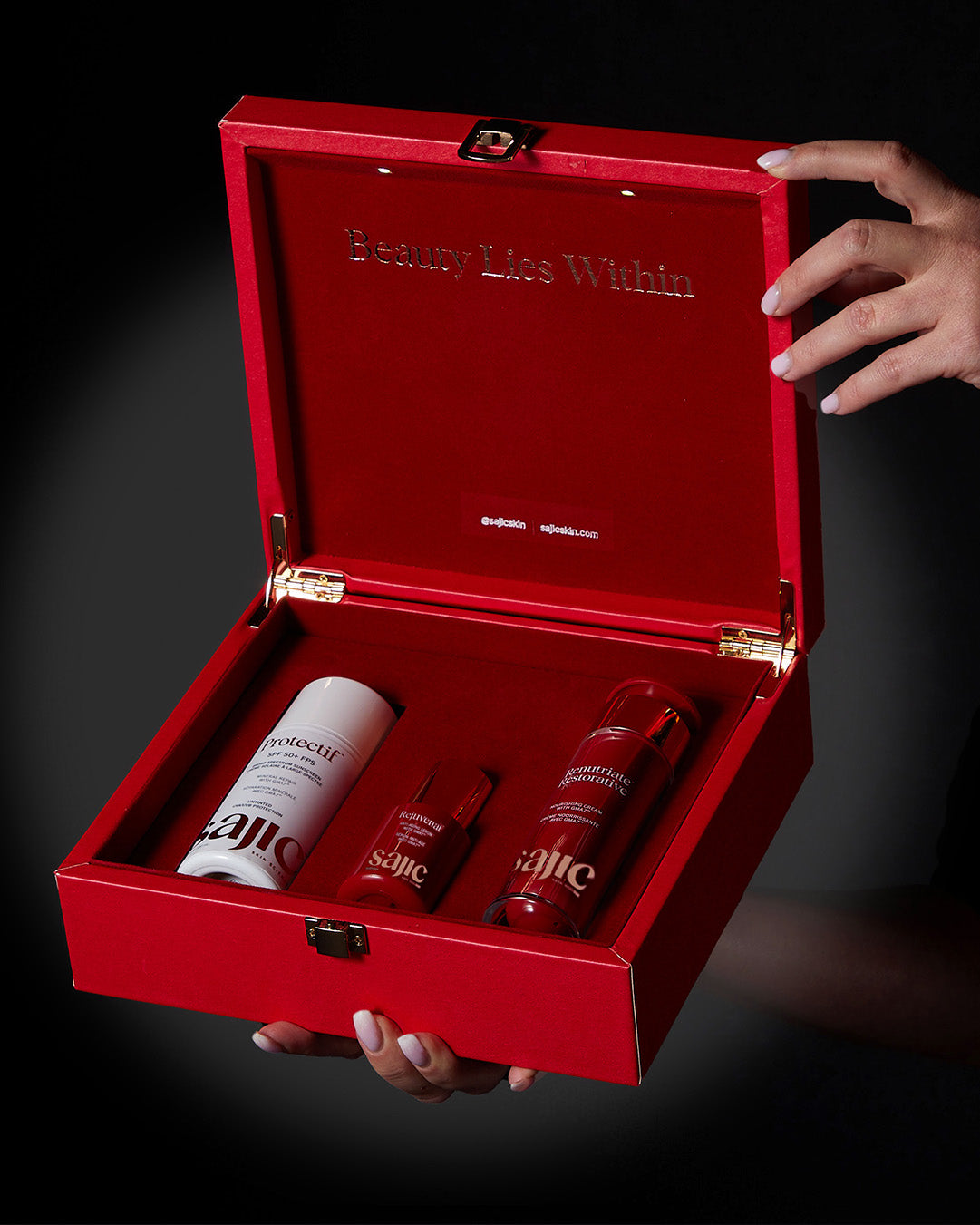
The practical takeaway: retinaldehyde is the sweet spot for most people — it's roughly 11 times more potent than retinol because it's one conversion step closer to the active form, yet it causes significantly less irritation than prescription tretinoin (Fluhr et al., 1999, Dermatology). This is why Sajic Rejuvenat® is formulated with retinaldehyde rather than plain retinol.
How retinoids actually work
The conversion pathway
Your skin cells can only bind and use one form of vitamin A: retinoic acid. It's the molecule that activates retinoic acid receptors (RAR) in the cell nucleus, triggering the genetic changes that increase collagen production, accelerate cell turnover, and normalise keratinisation (Mukherjee et al., 2006). Every other retinoid — retinol, retinaldehyde, retinyl esters — must be enzymatically converted into retinoic acid before it can do anything.
The conversion pathway runs: retinyl ester → retinol → retinaldehyde → retinoic acid. Each step is an oxidation reaction requiring specific enzymes. Every step loses some efficiency. This is why the further down the pathway a topical retinoid starts, the more active retinoic acid ultimately reaches the receptors — and the more potent the clinical effect (Sorg et al., 2006, Dermatology).
What retinoids do at the cellular level
Once retinoic acid binds RAR receptors, it upregulates procollagen I and III synthesis, inhibits matrix metalloproteinases (the enzymes that break down collagen), thickens the epidermis, and normalises melanocyte activity to fade hyperpigmentation (Kang et al., 2005, Journal of the American Academy of Dermatology). Over months, this produces measurable reductions in fine lines, improved skin firmness, more even tone, and refined texture. Retinoids remain the single most evidence-backed topical anti-aging ingredient class in dermatology.

Retinol: the gentle standard
What it is and who it's for
Retinol is the most widely available OTC retinoid — two conversion steps from active retinoic acid. It's the entry point for most people because it's gentle, widely tested, and available at every price point. The tradeoff: because it needs two oxidation steps, only a fraction of applied retinol becomes active retinoic acid in the skin (Sorg et al., 2006). To compensate, formulators use higher percentages — 0.5% to 1% — but percentage on the label doesn't equal potency at the receptor.
The stability problem
Retinol is notoriously unstable. It oxidises rapidly when exposed to light and air, degrading into inactive byproducts before it ever penetrates the skin (Temova Rakuša et al., 2021, Antioxidants). A retinol serum in a clear jar exposed to bathroom light may lose most of its activity within weeks of opening. This is why delivery and packaging matter as much as concentration — an unstable retinoid that degrades before use is worthless regardless of the number on the bottle.
Retinaldehyde: the sweet spot
Why one step makes such a difference
Retinaldehyde (also called retinal) sits one conversion step from active retinoic acid. That single-step advantage translates into roughly 11 times the biological potency of retinol at equivalent concentrations, according to comparative studies (Fluhr et al., 1999). Crucially, this potency comes without a proportional increase in irritation — retinaldehyde consistently causes less erythema, peeling, and stinging than both high-percentage retinol and prescription tretinoin (Boisnic et al., 2015, Clinical, Cosmetic and Investigational Dermatology).
The evidence base
A landmark comparison found 0.05% retinaldehyde produced anti-aging results approaching 0.05% tretinoin with markedly better tolerability (Diridollou et al., 1999, British Journal of Dermatology). Retinaldehyde also has documented antibacterial properties against Cutibacterium acnes, making it useful for acne-prone aging skin — a category tretinoin serves but retinol serves poorly (Pechère et al., 2002, Dermatology).
Why Rejuvenat uses retinaldehyde
Sajic Rejuvenat® is built on retinaldehyde precisely because it delivers near-prescription efficacy at over-the-counter tolerability. But retinaldehyde shares retinol's stability challenge — it degrades with light and air exposure. The GMA7® delivery system addresses this by stabilising the retinaldehyde and carrying it past the stratum corneum to the living epidermis where conversion to retinoic acid occurs. Paired with five repair peptides, photolyase, and niacinamide, Rejuvenat delivers the retinaldehyde within a complete repair matrix rather than as an isolated, unstable active.
Retinoic acid (tretinoin): the prescription standard
Maximum potency, maximum caution
Tretinoin is retinoic acid itself — no conversion needed, immediately active, prescription-only in most countries. It has the deepest evidence base of any topical anti-aging molecule, with decades of trials documenting collagen synthesis, wrinkle reduction, and photodamage reversal (Kang et al., 2005). It is also the most irritating: the "retinoid uglies" phase of redness, peeling, and purging is most pronounced with tretinoin. For patients who can tolerate it — and who are monitored by a dermatologist — it remains the gold standard for aggressive photoaging and acne.
When prescription is the right call
Tretinoin makes sense for patients with significant photodamage, stubborn hyperpigmentation, active acne, or those who've plateaued on OTC retinoids. It requires medical supervision, careful titration, and strict photoprotection. A dermatologist can compound prescription retinoids into a barrier-supportive base — combining the potency of tretinoin with ceramides to offset irritation, personalised to your tolerance.
How to choose and use your retinoid
The decision framework
New to retinoids or sensitive skin: start with retinaldehyde (like Rejuvenat) — best tolerability-to-efficacy ratio. Experienced and want more: prescription tretinoin under dermatologist supervision, ideally compounded in a barrier-supportive base. Budget-focused or very sensitive: a well-formulated, well-packaged retinol — but prioritise stability (airless, opaque packaging) over a high percentage number. If even retinol proves too irritating, a non-retinoid alternative such as bakuchiol can deliver comparable anti-aging benefits with far less irritation.
Universal usage rules
Regardless of which retinoid you choose: start 2–3 nights per week and build up. Apply to dry skin (damp skin increases penetration and irritation). Always follow with a moisturizer. And always pair with mineral SPF every morning — retinoids increase photosensitivity while they repair photodamage, so unprotected sun exposure undoes the work. Protectif® mineral SPF 50+ with photolyase is the ideal daytime partner: it blocks new UV damage while its photolyase enzyme repairs existing DNA damage.
Frequently asked questions
Is a higher percentage always better?
No — and this is the most common misconception. A 0.1% retinaldehyde outperforms a 1% retinol because it's biologically one step closer to active retinoic acid. Percentage only matters within the same retinoid type. Comparing percentages across different retinoids is meaningless; what matters is how much active retinoic acid ultimately reaches your receptors, which depends on the starting molecule, its stability, and the delivery system.
Can I use retinaldehyde and vitamin C together?
Yes, though many prefer vitamin C in the morning and retinaldehyde at night to optimise each. Rejuvenat contains both retinaldehyde and stabilised vitamin C in one formulation, engineered to coexist. If layering separate products, allow each to absorb before applying the next.
How long until I see results?
Texture and tone improvements typically appear in 4–8 weeks. Collagen-driven changes — firmness, fine line reduction — take 12 weeks to 6 months of consistent use. Retinoids reward consistency; sporadic use produces sporadic results.
What is retinoid purging and is it normal?
Purging — a temporary increase in breakouts when starting a retinoid — happens because accelerated cell turnover brings existing micro-comedones to the surface faster. It's most common with tretinoin, less so with retinaldehyde, and typically resolves within 4–6 weeks. Persistent irritation beyond that suggests you're using too high a strength too frequently — scale back.
The bottom line
The retinoid hierarchy comes down to conversion steps: fewer steps means more active retinoic acid reaching your receptors. Retinaldehyde is the practical winner for most people — near-prescription efficacy, over-the-counter tolerability. Retinol is the gentle entry point; tretinoin is the prescription maximum for those who need and can tolerate it.
Sajic Rejuvenat® is built on retinaldehyde in the GMA7® delivery system precisely because it delivers the best of both worlds — meaningful anti-aging results without the irritation that makes so many people quit retinoids entirely. And if you need prescription strength, a dermatologist can compound tretinoin into a barrier-supportive base, personalised to your skin. Whichever you choose, pair it with mineral SPF and give it time.
References
- Mukherjee S, Date A, Patravale V, et al. Retinoids in the treatment of skin aging: an overview of clinical efficacy and safety. Clinical Interventions in Aging. 2006;1(4):327-348. doi.org/10.2147/ciia.2006.1.4.327
- Fluhr JW, Vienne MP, Lauze C, et al. Tolerance profile of retinol, retinaldehyde and retinoic acid under maximized and long-term clinical conditions. Dermatology. 1999;199(Suppl 1):57-60. doi.org/10.1159/000051381
- Sorg O, Antille C, Kaya G, Saurat JH. Retinoids in cosmeceuticals. Dermatologic Therapy. 2006;19(5):289-296. doi.org/10.1111/j.1529-8019.2006.00086.x
- Diridollou S, Vienne MP, Alibert M, et al. Efficacy of topical 0.05% retinaldehyde in skin aging by ultrasound and rheological techniques. Dermatology. 1999;199(Suppl 1):37-41. doi.org/10.1159/000051376
- Kang S, Bergfeld W, Gottlieb AB, et al. Long-term efficacy and safety of tretinoin emollient cream 0.05% in the treatment of photodamaged facial skin. American Journal of Clinical Dermatology. 2005;6(4):245-253. doi.org/10.2165/00128071-200506040-00005
- Boisnic S, Branchet MC, Gaspar K, et al. Clinical and biological effects of retinaldehyde. Clinical, Cosmetic and Investigational Dermatology. 2015;8:439-446. doi.org/10.2147/CCID.S86049
- Pechère M, Germanier L, Siegenthaler G, et al. The antibacterial activity of topical retinoids: the case of retinaldehyde. Dermatology. 2002;205(2):153-158. doi.org/10.1159/000063903
- Temova Rakuša Ž, Škufca P, Kristl A, Roškar R. Retinoid stability and degradation kinetics in commercial cosmetic products. Antioxidants. 2021;10(11):1732. doi.org/10.3390/antiox10111732
- Zasada M, Budzisz E. Retinoids: active molecules influencing skin structure formation in cosmetic and dermatological treatments. Advances in Dermatology and Allergology. 2019;36(4):392-397. doi.org/10.5114/ada.2019.87443
- Riahi RR, Bush AE, Cohen PR. Topical retinoids: therapeutic mechanisms in the treatment of photodamaged skin. American Journal of Clinical Dermatology. 2016;17(3):265-276. doi.org/10.1007/s40257-016-0185-5
- Shao Y, He T, Fisher GJ, Voorhees JJ, Quan T. Molecular basis of retinol anti-aging properties in naturally aged human skin in vivo. International Journal of Cosmetic Science. 2017;39(1):56-65. doi.org/10.1111/ics.12348
This article is for informational purposes only and does not constitute medical advice. Prescription retinoids require a valid prescription following medical review. Always consult a qualified dermatologist for individual guidance.
About the author
Dr. Dusan Sajic, MD, PhD, FRCPC, FAAD is a board-certified dermatologist with 22+ years of clinical experience, Past President of CLASS (Canadian Laser and Aesthetic Specialists Society), TEDx speaker, and inventor of GMA7® (Genoplex Microdelivery Activator). He formulated Rejuvenat® with retinaldehyde stabilised in the GMA7® delivery system and continues to lead product development from his clinic in Ontario, Canada. Meet Dr. Sajic →


