



Answer-First: Skin dysbiosis is the imbalance of microorganisms living on the skin's surface, including bacteria, fungi, and viruses. With age, the skin microbiome loses diversity and protective species decline, contributing to inflammaging, slower wound healing, and accelerated visible aging. Dysbiosis was added as the newest hallmark of aging by López-Otín et al., Cell 2023.
Last clinically reviewed by Dr. Dusan Sajic, MD, FRCPC, FAAD on 2026-05-26.
This article is part of our complete guide to the 12 Hallmarks of Aging. It is spoke #12 in the Pillar 1 series, and the most recently identified hallmark.
---
What is the skin microbiome?
The skin microbiome is the community of bacteria, fungi, viruses, and mites living on and inside the skin. Healthy adult skin hosts roughly one million microbes per square centimeter across more than 1,000 species (Byrd et al., Nature Reviews Microbiology, 2018). Diversity, not sterility, defines a healthy skin ecosystem.
Which microbes live on healthy skin?
Three groups dominate the surface ecosystem of adult skin:
- Bacteria. Cutibacterium acnes (formerly Propionibacterium) thrives in oily zones like the face and chest. Staphylococcus epidermidis covers most skin sites and produces antimicrobial peptides that suppress pathogenic S. aureus. Corynebacterium species appear in moist areas like axillae and groin.
- Fungi. Malassezia yeasts dominate sebum-rich regions and outnumber other fungi by orders of magnitude on the face and scalp.
- Viruses and mites. Bacteriophages regulate bacterial populations, and Demodex mites colonize the follicles of nearly every adult, usually without disease.
Why diversity matters more than sterility
A diverse microbiome is a stable microbiome. When many species occupy overlapping niches, no single organism can overgrow and trigger disease. Boxberger et al., Microbiome, 2021 frames the modern view: targeting "germs" with broad antimicrobials breaks this stability and is implicated in conditions ranging from atopic dermatitis to acne flares.
Twenty years ago, dermatology training framed skin bacteria as adversaries. The 2010s and 2020s flipped that picture. The microbiome behaves more like a rainforest than a battlefield: clear-cutting it with harsh actives causes more long-term harm than the pathogens it was meant to remove.
Citation capsule: Healthy human skin hosts more than 1,000 microbial species across distinct topographic niches, with Byrd et al., Nature Reviews Microbiology, 2018 establishing the foundational map of skin microbial communities. Boxberger et al., Microbiome, 2021 reviews how diversity, not sterility, predicts barrier health and resilience to disease.
---
How does the skin microbiome change with age?
The skin microbiome loses diversity, shifts species composition, and reorganizes around lower sebum production starting in the fifth decade. Shibagaki et al., Scientific Reports, 2017 sequenced 16S rRNA across 162 women and showed that older skin has fewer Cutibacterium and more Corynebacterium, Acinetobacter, and other environmental species, signaling a less-protected ecosystem.
What changes after 40?
Three shifts matter most:
- *Loss of Cutibacterium acnes. Sebum output declines roughly 30% per decade after age 30 (Pochi et al., Journal of Investigative Dermatology, 1979). C. acnes* depends on sebum lipids; its populations fall as the niche disappears, and protective porphyrin and propionic acid production drops with it.
- Rise of environmental species. Less-specialized organisms colonize the freed niche. Many produce more pro-inflammatory cell-wall fragments than the specialists they displace.
- Reduced antimicrobial peptide output. Aging keratinocytes produce less cathelicidin and beta-defensin, weakening the chemical barrier that keeps the ecosystem in check (Gunathilake et al., Journal of Investigative Dermatology, 2009).
How estrogen decline reshapes the microbiome
Menopause accelerates microbiome change. Estrogen supports sebum production, ceramide synthesis, and skin pH regulation; its loss thins the lipid mantle and raises surface pH from roughly 4.7 toward 5.5 or higher. Higher pH favors S. aureus and Corynebacterium over S. epidermidis and C. acnes, tilting the ecosystem toward more inflammatory species.
How sun exposure rewires surface flora
UV is not just a senescence trigger; it directly perturbs the microbiome. Existing Sajic research summarized in our microbiome and ultraviolet radiation review shows UVB alters bacterial gene expression, kills sensitive species, and selects for resistant strains. The surviving population is less diverse and more pro-inflammatory.
Citation capsule: Shibagaki et al., Scientific Reports, 2017 used 16S rRNA sequencing across 162 women to show that older skin has reduced Cutibacterium abundance and elevated Corynebacterium and Acinetobacter populations. Combined with the steep decline in sebum production after age 30 (Pochi et al., 1979), the data confirm a measurable, predictable age-related drift in surface microbial composition.
---

What is dysbiosis and what does it do to skin?
Dysbiosis is microbial imbalance: loss of diversity, overgrowth of opportunists, or disrupted spatial organization. In skin, dysbiosis manifests as visible inflammation, weakened barrier, and conditions like rosacea, atopic dermatitis, and adult acne. López-Otín et al., Cell, 2023 added dysbiosis as the twelfth and newest hallmark of aging because the same microbial drift drives systemic inflammation across multiple organ systems.
How dysbiosis breaks the skin barrier
The barrier and the microbiome are one system. Resident flora produce lipids, antimicrobial peptides, and short-chain fatty acids that keep stratum corneum pH low and tight junctions tight. When diversity drops, fewer of these protective molecules are produced. The barrier weakens, transepidermal water loss rises, and pathogens that were excluded by competition gain a foothold.
Why dysbiosis is contagious with inflammaging
Imbalanced skin flora chronically activate Toll-like receptors (TLRs) on keratinocytes and immune cells. The result is steady-state, low-grade inflammation, the same definition of inflammaging (spoke #11 of this series). Inflammaging then accelerates cellular senescence, and senescent cells release SASP cytokines that further alter the microbial ecosystem. Dysbiosis, inflammaging, and senescence form a mutually reinforcing triangle of skin aging.
Which conditions are tied to dysbiosis?
Three common dermatologic conditions show clear microbial imbalance:
- Rosacea. Increased Demodex folliculorum density and altered Bacillus oleronius exposure correlate with rosacea severity (Forton & De Maertelaer, British Journal of Dermatology, 2018).
- Atopic dermatitis. S. aureus overgrowth replaces protective S. epidermidis, with severity tracking the S. aureus load (Kong et al., Genome Research, 2012).
- Adult acne. Loss of C. acnes phylotype diversity, not absolute C. acnes count, predicts inflammatory acne severity.
What dysbiosis looks like clinically
In practice, dysbiosis appears as:
- Persistent low-grade redness and reactivity
- Sensitivity to products previously tolerated
- Slow wound healing after procedures
- Worsening rosacea or eczema flares despite topical treatment
- Adult-onset acne that does not respond to standard therapy
In 22 years of practice, the patients who improve most when I rebuild their routine around microbiome support are usually those who arrive with three or four "active" products in their cabinet. The fix is rarely a new ingredient; it is removing the harsh ones and letting the ecosystem repopulate.
Citation capsule: Dysbiosis is the twelfth hallmark of aging in the updated taxonomy of López-Otín et al., Cell, 2023. In skin specifically, S. aureus overgrowth tracks atopic dermatitis severity (Kong et al., Genome Research, 2012), elevated Demodex density associates with rosacea (Forton & De Maertelaer, British Journal of Dermatology, 2018), and reduced microbial diversity correlates with the chronic low-grade inflammation that defines inflammaging.
---
Probiotic vs prebiotic vs postbiotic skincare: what is actually proven?
The honest answer is that most "probiotic skincare" on the shelf is not probiotic. Live bacteria do not survive in surfactant-rich, pH-controlled, preservative-laden cosmetic emulsions. The category that has clinical evidence is postbiotics: bacterial lysates and ferments that retain biological activity without requiring live organisms.
What the three terms actually mean
- Probiotic. Live microorganisms that confer a health benefit when applied. Requires the organism to remain viable through manufacturing, storage, and use.
- Prebiotic. A substrate that selectively feeds beneficial resident flora. Examples include alpha-glucan oligosaccharides and inulin.
- Postbiotic. Inactivated microorganisms or their metabolites (lysates, ferments, fragments) that retain biological signaling activity.
Why most "live probiotic" claims fail
Cosmetic preservation systems exist to kill microbes. Adding live probiotics to a preserved emulsion is a contradiction. A handful of refrigerated, water-free, or single-use formats sustain viability, but the typical jar or pump bottle on a bathroom counter does not. When I review formulation specs from suppliers pitching "probiotic" raw materials, the supporting documents almost always describe a postbiotic, a lysate, or a ferment filtrate. The marketing label outpaces the chemistry.
What the evidence supports
- Postbiotic ferments. Galactomyces ferment filtrate, Lactobacillus ferment lysate, and Bifida ferment lysate have published studies showing reduced inflammatory markers and improved barrier function.
- Prebiotic substrates. Alpha-glucan oligosaccharides selectively feed S. epidermidis and have shown microbiome rebalancing in small clinical studies.
- pH-supportive formulations. Cleansers and toners that maintain skin pH near 5.0 protect resident flora more reliably than any added "probiotic" claim.
Selective antimicrobials that support balance
Not every antimicrobial is microbiome-hostile. Hydroxytyrosol, the olive-derived polyphenol summarized in our hydroxytyrosol research review, shows selective activity: stronger against opportunistic S. aureus than commensal S. epidermidis in laboratory comparisons. Selective inhibition is the goal, not blanket sterilization. Hydroxytyrosol is a key actor in Rejuvenat.
Citation capsule: Live probiotic survival in standard cosmetic emulsions is unsupported by formulation chemistry, and most marketed "probiotic" products contain postbiotics. Boxberger et al., Microbiome, 2021 reviews evidence for prebiotics and postbiotics, finding the strongest data for Lactobacillus and Bifida ferment lysates and for alpha-glucan oligosaccharide prebiotics, with clinical endpoints in barrier and inflammation markers rather than wrinkle reduction.
---
What is Dr. Sajic's microbiome-supportive protocol?
A microbiome-supportive routine prioritizes what you stop doing as much as what you add. The five-step protocol below is built around protecting resident flora rather than aggressively reseeding it. Visible improvements in tone, texture, and reactivity typically appear at 6-10 weeks.
Step 1: Use a pH-balanced, non-stripping cleanser
A pH near 5.0 keeps the lipid mantle intact and supports S. epidermidis and C. acnes. Avoid sulfate-heavy cleansers, high-foam formats, and anything labeled "antibacterial" for everyday use. Cleanse twice daily at most.
Step 2: Avoid over-cleansing and over-exfoliating
In my practice, the single most common cause of cosmetic dysbiosis is layered active products. Daily acid toners plus retinoids plus scrub cleansers strip flora faster than any single product would. Cycle actives instead of stacking them.
Step 3: Add antioxidant and selective antimicrobial support
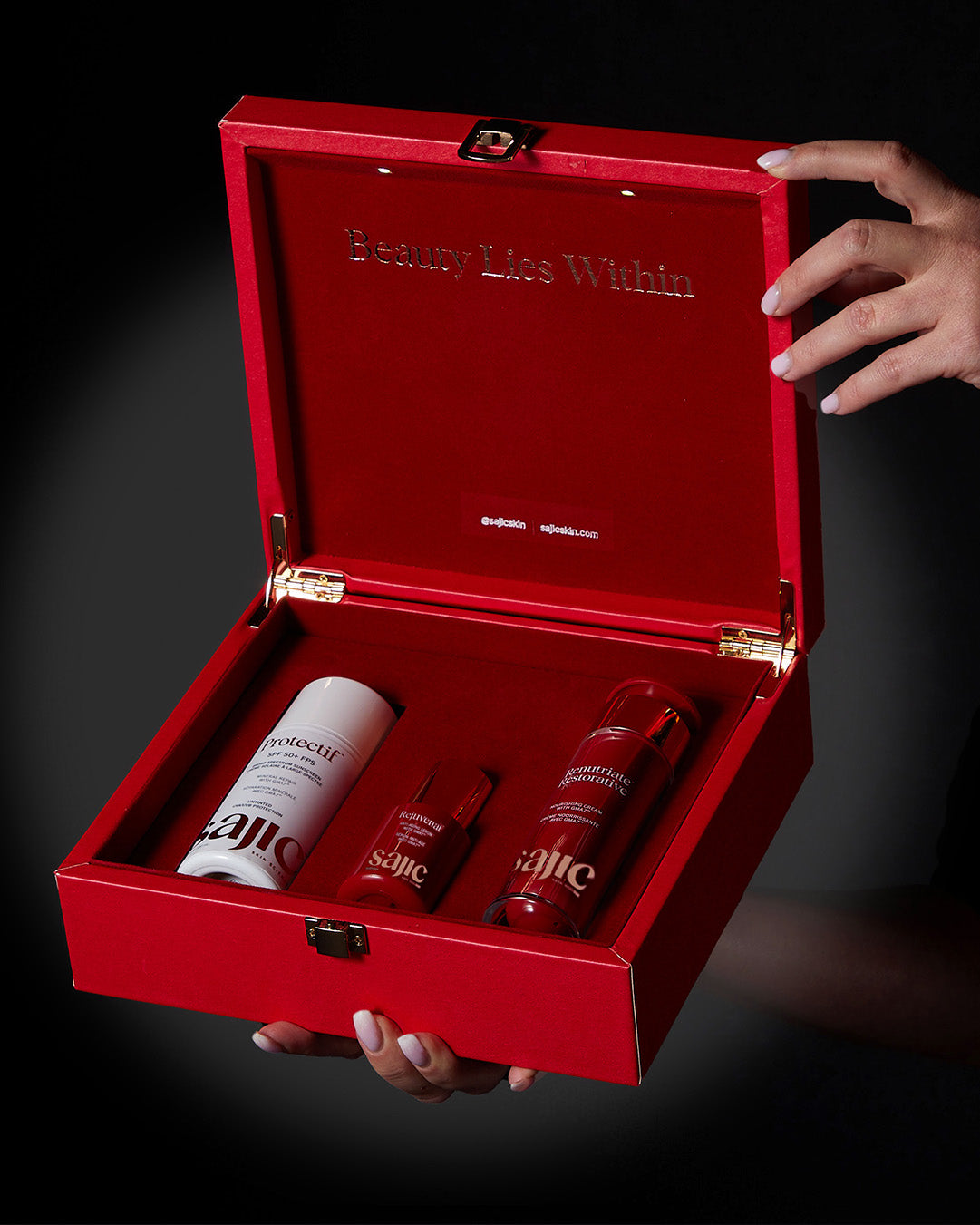
Hydroxytyrosol-based formulations support flora balance through selective antimicrobial action and antioxidant defense against UV-driven microbial perturbation. Rejuvenat pairs hydroxytyrosol with the GMA7 delivery technology so the active reaches the dermis without disrupting the surface ecosystem.
Step 4: Protect the barrier with ceramides and peptides
Ceramide-supportive moisturizers replenish the lipid lattice that keeps flora in their proper niches. Peptide formulations like Renutriate reinforce barrier signaling without surfactant-driven flora disruption.
Step 5: Daily UV protection
UV directly damages microbial DNA and shifts community composition. Daily mineral sunscreen protects both the barrier and the microbiome. This step links dysbiosis prevention to cellular senescence prevention and inflammaging control, the other two corners of the aging-skin triangle.
What to skip
Skip benzoyl peroxide as a long-term daily product unless treating active acne. Skip antibacterial soaps. Skip "deep clean" routines that strip oil from a sebum-poor 50-year-old face. The microbiome on aging skin is fragile; the goal is restoration, not eradication.
---
Frequently asked questions
Are probiotic skincare products clinically proven?
Most marketed "probiotic" products are postbiotics, containing bacterial lysates or ferment filtrates rather than live organisms. Postbiotic ingredients like Lactobacillus ferment lysate and Galactomyces ferment filtrate have published evidence for barrier and inflammation endpoints (Boxberger et al., Microbiome, 2021). True live-probiotic skincare with sustained viability remains rare and largely unproven for visible aging.
Does retinol disrupt the skin microbiome?
Retinol can transiently shift surface flora through accelerated keratinocyte turnover and reduced sebum, particularly during the first 4-8 weeks of use. The shift is usually reversible and not equivalent to pathologic dysbiosis. Patients with sensitive or rosacea-prone skin may benefit from bakuchiol as a gentler alternative (Sajic et al., 2021, PMID 33740839).
What is the best ingredient for microbiome-supportive skincare?
No single ingredient is best. The strongest evidence-based approach combines a pH-balanced cleanser, prebiotic substrates like alpha-glucan oligosaccharides, postbiotic ferments, and selective antimicrobials like hydroxytyrosol that suppress S. aureus without harming S. epidermidis. Daily mineral sunscreen prevents UV-driven microbial damage and is foundational (Byrd et al., 2018).
Can dysbiosis cause acne?
Yes. Loss of C. acnes phylotype diversity rather than absolute C. acnes count predicts inflammatory acne severity. Adult acne in particular is frequently a dysbiosis pattern: harsh routines strip flora, opportunistic species expand, and inflammation rises. Restoring diversity through gentle cleansing and selective postbiotics often outperforms aggressive antibacterial regimens.
How long does it take to restore skin microbiome balance?
Surface microbiome composition begins to recover within days of stopping disruptive products. Visible barrier and inflammation improvements typically appear at 4-8 weeks. Full ecosystem rebalancing in chronically dysbiotic skin can take 3-6 months and requires consistent gentle cleansing, simplified actives, and avoidance of antibacterial agents.
Should I avoid antibacterial cleansers?
Yes for daily skincare use. Triclosan, benzalkonium chloride, and benzoyl peroxide as standing-routine products kill commensal flora alongside any pathogens, accelerating dysbiosis. They have legitimate roles in active acne or post-procedure care but should not be the default daily cleanser, especially after age 40 when flora are already declining.
Does the skin microbiome affect wrinkles?
Indirectly, yes. The microbiome does not produce collagen, but dysbiosis drives chronic low-grade inflammation that activates matrix metalloproteinases, the same enzymes that degrade collagen and elastin in cellular senescence. Microbial balance is therefore an upstream lever for wrinkle prevention, working through the inflammaging pathway rather than directly on dermal structure.
---
About the author
Dr. Dusan Sajic, MD, FRCPC, FAAD is a board-certified dermatologist with 22+ years of clinical practice. He earned his MD from McMaster University, holds FRCPC and FAAD certifications, authored peer-reviewed research in the Journal of Cosmetic Dermatology (PMID 33740839), invented the patented GMA7 delivery technology, and is Past President of CLASS (Canadian Laser and Aesthetic Specialists Society). Read his full founder profile for credentials and verification links.
Last clinically reviewed: 2026-05-26.
---
References & Further Reading
- Grice EA, Segre JA. The skin microbiome. Nat Rev Microbiol. 2011;9(4):244-253. doi.org/10.1038/nrmicro2537
- Byrd AL, Belkaid Y, Segre JA. The human skin microbiome. Nat Rev Microbiol. 2018;16(3):143-155. doi.org/10.1038/nrmicro.2017.157
- Sanford JA, Gallo RL. Functions of the skin microbiota in health and disease. Semin Immunol. 2013;25(5):370-377. doi.org/10.1016/j.smim.2013.09.005
- Belkaid Y, Tamoutounour S. The influence of skin microorganisms on cutaneous immunity. Nat Rev Immunol. 2016;16(6):353-366. doi.org/10.1038/nri.2016.48
- Naik S, Bouladoux N, Wilhelm C, et al. Compartmentalized control of skin immunity by resident commensals. Science. 2012;337(6098):1115-1119. doi.org/10.1126/science.1225152
- Boxberger M, Cenizo V, Cassir N, La Scola B. Challenges in exploring and manipulating the human skin microbiome. Microbiome. 2021;9(1):125. doi.org/10.1186/s40168-021-01062-5
- Howard B, Bascom CC, Hu P, et al. Aging-Associated Changes in the Adult Human Skin Microbiome and the Host Factors that Affect Skin Microbiome Composition. J Invest Dermatol. 2022;142(7):1934-1946.e21. doi.org/10.1016/j.jid.2021.11.029
- Bouslimani A, da Silva R, Kosciolek T, et al. The impact of skin care products on skin chemistry and microbiome dynamics. BMC Biol. 2019;17(1):47. doi.org/10.1186/s12915-019-0660-6
- Schommer NN, Gallo RL. Structure and function of the human skin microbiome. Trends Microbiol. 2013;21(12):660-668. doi.org/10.1016/j.tim.2013.10.001
- Egert M, Simmering R, Riedel CU. The Association of the Skin Microbiota With Health, Immunity, and Disease. Clin Pharmacol Ther. 2017;102(1):62-69. doi.org/10.1002/cpt.698
- Dréno B, Araviiskaia E, Berardesca E, et al. Microbiome in healthy skin, update for dermatologists. J Eur Acad Dermatol Venereol. 2016;30(12):2038-2047. doi.org/10.1111/jdv.13965
- Costello EK, Lauber CL, Hamady M, Fierer N, Gordon JI, Knight R. Bacterial community variation in human body habitats across space and time. Science. 2009;326(5960):1694-1697. doi.org/10.1126/science.1177486
This article is for informational purposes only and does not constitute medical advice. Always consult a qualified healthcare professional for diagnosis and treatment decisions.


